Share This

Wednesday, 7 May 2025

China establishes world's first three-satellite constellation in the Earth-moon region of space; Space rescue: Chinese astro-engineers share a satellite-saving mission that spans 123 days and covers 8.5 million kilometers
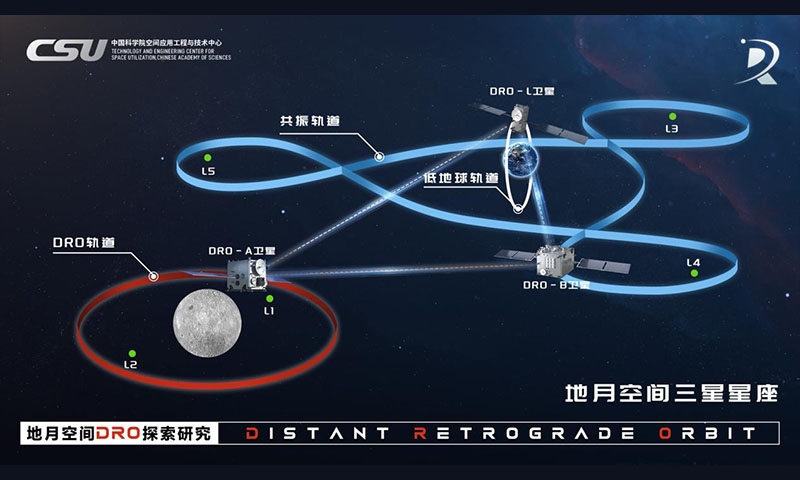


Photo: CCTV News


China has successfully established the world's first three-satellite constellation on the distant retrograde orbit (DRO) in the Earth-moon region of space, connecting them with stable inter-satellite measurement and communication links, Global Times learned from program developer the Chinese Academy of Sciences (CAS).  

Such development has yielded variety of original scientific and technology outcomes, laying a solid ground for the country's future development of the Earth-moon region of space and frontier exploration of the space science, the CAS disclosed in the statement it provided to the Global Times on Wednesday. 

Per the CAS, the Earth-moon region of space refers to the expanded domain extending outward from Earth's orbit, reaching up to 2 million kilometers from Earth. Compared to Earth's orbital space, its three-dimensional volume expands by more than a thousand times, the academy explained. 

Developing and utilizing cislunar space holds tremendous strategic significance for lunar resource exploitation, long-term human habitation beyond Earth, interplanetary activities, and the sustainable exploration of the solar system, it added. 

The CAS launched preliminary research and key technology development in this region in 2017. In February 2022, a pilot project was initiated to develop and launch three satellites to form a large-scale satellite constellation in the region of space, aimed at exploring the unique characteristics and application potential of the DRO.

The DRO-A and -B satellites were launched in March 2024, and entered their mission orbit on July 15 the same year, while the DRO-L was launched in February 2024 into a sun-synchronous orbit and began conducting experiments as planned. The three formed the constellation for the first time in August 2024. 

The plan included DRO-A satellite permanently staying in the DRO, while the DRO-B satellite operates in Earth-moon space maneuver orbits, according to CAS' Technology and Engineering Center for Space Utilization (CSU.)

Chinese scientists have made significant breakthroughs in ranging fields since the set-up of the three-satellite constellation in 2024.

Building on years of research in Earth-moon region of space astrodynamics and space exploration, the scientific team proposed an innovative design concept: trading longer flight time for increased payload capacity and greater contingency margin. As a result, the satellites completed Earth-moon transfer and achieved low-energy DRO insertion using only one-fifth of the fuel required by traditional methods, marking the world's first successful low-energy insertion into a DRO. 

This breakthrough significantly reduces the cost of accessing cislunar space, opening up new avenues for large-scale development and utilization.

The team also achieved another world-first by successfully verifying a 1.17-million-kilometer K-band inter-satellite microwave measurement and communication link, overcoming a major technological bottleneck in building large-scale constellations in cislunar space. 

In terms of space science, the mission has also supported astrophysical research such as gamma-ray burst detection and trialed new technologies, including operating atomic clocks.

Moreover, Chinese researchers successfully validated a new space-based orbit determination system whereby one satellite tracks another, replacing traditional ground-based tracking. Using just three hours of inter-satellite measurement data, they achieved orbit determination accuracy equivalent to over two days of traditional ground tracking. This breakthrough significantly lowers the cost of orbit determination for cislunar spacecraft, paving the way for more efficient operations.

Wang Wenbin, a researcher at CSU, hailed that this achievement marks the first time internationally that orbit determination was verified using satellite-to-satellite tracking rather than ground stations. 

"It's like turning a traditional ground station into a satellite and placing it in a low-Earth orbit," he explained. "This opens a new technical pathway for China's future cislunar and deep space exploration. It also provides an efficient solution for orbit determination, navigation, and timing across various cislunar orbits, supporting the future expansion of large-scale commercial activity in cislunar space."

Researchers told the Global Times on Wednesday that the program would support China's future lunar exploration mission, including providing space-based inter-satellite measurement for rapid orbit determination and autonomous navigation services for lunar exploration mission orbiters, and supply high-precision time signals for lunar surface facilities. 

Additionally, as the DRO is far from Earth and the moon, free from obstructions, it could facilitate the establishment of communication links with lunar exploration mission spacecraft, and assist in the downlink of critical or emergency data, researchers explained.

Space rescue: Chinese astro-engineers share a satellite-saving mission that spans 123 days and covers 8.5 million kilometers

Photo: CCTV News

A diagram of the world's first three-satellite constellation on the distant retrograde orbit (DRO) in the Earth-moon region established by China Photo: Courtesy of the Technology and Engineering Center for Space Utilization, Chinese Academy of Sciences


China has successfully established the world's first three-satellite constellation on the distant retrograde orbit (DRO) in the Earth-moon region of space, with the constellation operating stably for over 200 days, the Global Times learned at an academic seminar held by the project's developer, the Technology and Engineering Center for Space Utilization (CSU) at the Chinese Academy of Sciences (CAS) recently.

Apart from sharing this groundbreaking achievement, a particular detail discussed at the seminar attracted widespread attention: During the launch of two satellites in the three-satellite constellation - DRO-A and DRO-B - in March 2024, the mission once encountered anomalies. However, the situation was successfully navigated, under the 123-day dedicated efforts by the project's team at the center, with an average age of under 34.

What thrilling events unfolded during the rescue of the malfunctioning satellites, which were tens of thousands of kilometers away? What challenges did the program's team face and overcome? What significance does this launch hold for China's space endeavors and the development of humanity? The Global Times recently spoke with two participants from the project, who recounted how this young team turned a potential space disaster into a success. 

Anomaly in satellite launch

In mid-April, the CSU released images of a DRO-A satellite with its solar panel severely damaged.

The satellite, which is still operational, evokes Zhang Hao's memories of March 13, 2024. That evening, at 8:51 pm, China launched the DRO-A/B satellites using the Long March-2C carrier rocket with a Yuanzheng-1S (Expedition-1S) upper stage attached, from the Xichang Satellite Launch Center. It was a historic moment, marking China's first foray into the deep exploration of the DRO.

The DRO is a unique family of orbits between the Earth and the moon. A typical DRO is located around 310,000 to 450,000 kilometers from the Earth, or 70,000 to 100,000 kilometers from the moon. Compared to other orbits, the DRO offers greater stability, allowing spacecraft to remain in position for hundreds of years without frequent adjustments. It is regarded by the aerospace community as a "natural harbor in the Earth-moon space." Following the launch of the DRO-A/B satellites, they are expected to work in conjunction with the previously launched DRO-L satellite, to establish K-band microwave inter-satellite measurement and communication links.

"Together, they will form a lighthouse or a beacon for further deep space exploration by us," Zhang, a research fellow at the CSU, told the Global Times.

However, shortly after the launch that evening, news of an "anomaly during the DRO-A/B satellite launch" drew public attention: While the first and second stages of the rocket flew normally, the upper stage, which is directly responsible for placing the satellites in their designated orbit, experienced an anomaly, resulting in the satellites not reaching their intended trajectory. 

Zhang, responsible for orbital design and mission planning in this project, recalled details from that moment in the mission control center. At about 11 pm, signaling the imminent separation of the satellites from the rocket, the parameters representing the apogee height on the large screen suddenly fluctuated violently: The apogee height, which was supposed to steadily increase to 292,000 kilometers, instead oscillated like a roller coaster at just 150,000 kilometers.

Yin Yongchen, a third-year doctoral student at the University of the Chinese Academy of Sciences (UCAS), is one of the Gen Z members of the project team. That night, the 24-year-old, who was busy with the relevant Ground System and was not directly aware of the situation on-site, recalled that several dozen minutes had passed beyond the expected time of the separation [of the satellites from the rocket] without any updates. 

"I felt a vague sense of unease," he said. As midnight approached, Yin received a message from Zhang informing him that there was indeed a problem with the launch. "My heart sank at that moment."

In this project, Yin's role primarily involved assisting Zhang with contingency planning prior to the satellite launch. Now that an emergency had truly arisen, he realized that their upcoming tasks would be even more challenging.

Finally, after approximately 40 minutes of losing contact, the Telemetry, Tracking, and Command (TT&C) system captured a flickering signal. The team discovered that the DRO-A/B satellite duo had been "thrown" into an orbit at an apogee of only 134,000 kilometers - far below the intended 292,000 kilometers. 

Worse still, it was spinning at over 200 degrees per second at that time. 

"If these satellites did not regain their status within a few hours, their power may run out, or if they continued spinning at such high speeds, they would fall apart, become multiple pieces of space debris," Zhang told the Global Times. 

"We needed to quickly and efficiently find a solution and implement it before that happened," Zhang said.
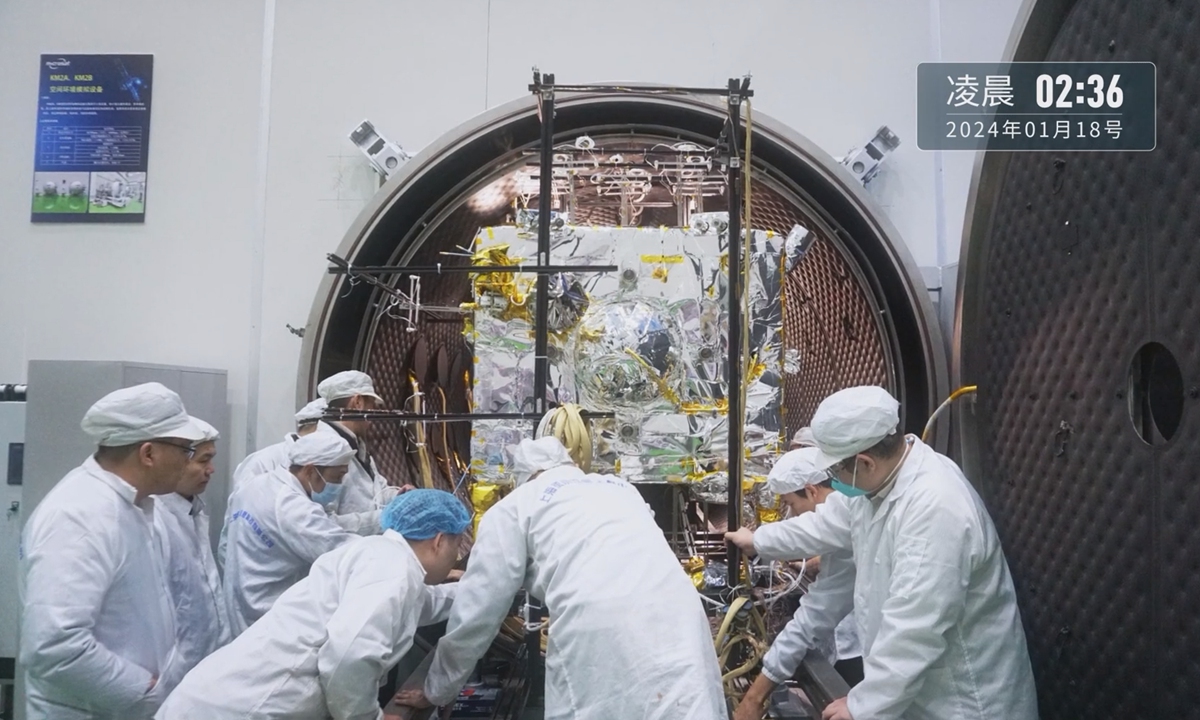
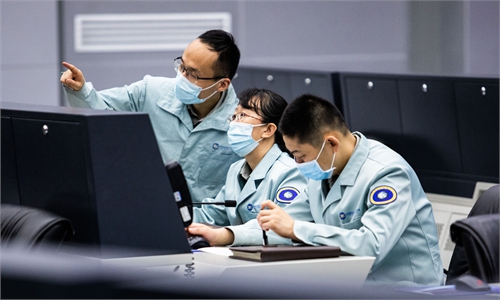
Aero-engineers work at the Technology and Engineering Center for Space Utilization (CSU), Chinese Academy of Sciences (CAS), on January 18, 2024. Photos on this page: Courtesy of the CSU

Aero-engineers work at the Technology and Engineering Center for Space Utilization (CSU), Chinese Academy of Sciences (CAS), on January 18, 2024. Photos on this page: Courtesy of the CSU


Youth power


The project team made multiple adjustments to the trajectory of the DRO-A/B satellite constellation in the following months. This "space rescue" was officially declared a success on July 15, 2024, lasting 123 days. Later, on August 28, DRO-A and DRO-B were successfully separated.

The project team accomplished this remarkable feat, covering approximately 8.5 million kilometers, while consuming only one fifth of the fuel typically required for such missions. The space rescue not only salvaged satellites, but also validated several "world firsts," such as low-energy transfer for the DRO spacecraft, inter-satellite communication over a distance of 1.17 million kilometers, and a new system for space-based orbit determination.

Zhang, who participated in the satellite launch control process for the first time, reflected on the valuable experience he gained during the mission. "In this rescue, we collaborated closely with people from different institutions, and I accumulated a lot of practical experience," he said. "More importantly, the successful orbital insertion of the satellite is only a beginning, subsequent on-orbit technical breakthrough and scientific discoveries are waiting ahead of us."

According to Zhang, the three-satellite constellation, which includes DRO-A, DRO-B, and the previously launched DRO-L, is expected to serve as a guiding beacon and communication hub for future space navigation. It can also function as space laboratories due to its unique gravitational field. Moreover, in the future, the constellation may serve as infrastructure for lunar resource development, and even pave the way for information highways for Mars exploration.

Despite the significance of the mission, the team executing it is remarkably young. A millennial himself, Zhang noted that most team members are millennials. He praised the Gen-Z students involved in the project for their strong technical skills, sense of responsibility, and passion for aerospace research. "The system of integrating research and education of UCAS, or more broadly, our national education system, has laid the foundation for the Gen-Z students to deal with these situations".

Yin recalled the overwhelming sense of achievement and joy he felt when the rescue was officially declared successful. "As a student, being part of this rescue and witnessing this historic moment in China's space history, is something I take great pride in," he told the Global Times.

May 4 marks China's Youth Day. Yin said that there are more and more young people like him who are proud of China's great achievements in space exploration, with a dream of embarking on a journey "to the sea of stars," by joining the aerospace industry. "It is truly an honor for our younger generation to witness, and even contribute to, China's rise as a space power," he said.

Get through challenges

An emergency rescue effort on the ground was mounted. Challenges came one after another.  

The first challenge was to stop the spinning 581-kilogram DRO-A/B satellite duo. The project team repeatedly uploaded contingency commands, modifying parameter thresholds, alternately using the engines of each satellite to eliminate the spinning. In an attempt to "talk" to the satellites, the flight control team had to issue each command multiple times. By around 3 am the next day, the satellite duo successfully ceased its high-speed spinning.

Next came the second challenge. Telemetry data indicated that the solar panel of the DRO-A satellite could not lock, while the solar panel of the DRO-B satellite was completely "dislocated." As the power source for the satellites, any anomaly with the solar panels could lead to a critical power shortage, risking total energy depletion.

The team urgently implemented a series of operations, including uploading attitude control commands, and repeatedly adjusting the sun-pointing attitude. At last, they managed to successfully "recharge" the satellite with the damaged solar panels.

Having overcome these two major challenges, the real test was just beginning. At the time, the apogee altitude of the DRO-A/B satellites was less than half of what was expected, and fuel reserves were critically low.

How could the satellites be brought back on track? Within 40 hours, the team members engaged in heated discussions, scribbling formulas, coding, and repeatedly calculating a plan to return the satellites to their intended orbit amid the complex influences of various gravitational forces. During this period, Zhang and some colleagues hardly rested. "I was highly tense and concentrated, and didn't even feel tired," said Zhang.

Majoring in Astrodynamics, Yin participated in the review of orbital control parameters during this rescue. The task required meticulousness and patience. Yin recalled that each review of the orbital control parameters was time-sensitive, necessitating timely command uploads to the satellites. 

Under pressure, Yin made a slight error in setting the engine parameters, which delayed the successful review of the parameters. "I was quite anxious at that moment, worried that my mistake would hinder the normal execution of the mission," he told the Global Times. The issue was later promptly identified and resolved with the help of the team's veteran members.

Time passed during the tense yet orderly rescue operation. At 12:42 pm on March 18, 2024, nearly five days after launching the first contingency orbital control maneuver, the apogee altitude of the satellites was successfully raised to the intended height of about 240,000 kilometers, bringing a sigh of temporary relief to the entire team. A few days later, the project team conducted a second perigee orbital maneuver, successfully elevating the combination to around 380,000 kilometers.

Reflecting on the process of overcoming each challenge with his coworkers, Zhang described their overall demeanor as "busy yet composed." He mentioned that before satellite launching, they would brainstorm in advance about potential malfunctions, and prepare relevant countermeasures.

Related posts

RELATED ARTICLES
China Has Quietly Won the Trade War—and Now Leads the World


Donald Trump-the noisy duck


China Has Quietly Won the Trade War—and Now Leads the World
Ricardo Martins 
    “There are decades where nothing happens; and there are weeks where decades happen.”
    —Vladimir Lenin

A Silent but Seismic Turning Point
In a silent but seismic shift, President Xi Jinping has ended five centuries of Western global dominance—not with bombs or blockades, but with strategic patience and unyielding confidence. Without firing a single shot, China has emerged not only as the victor of Trump’s chaotic trade war but also as the world’s new de facto leader.

This transformation did not happen overnight, but the past few years have accelerated an inevitable rebalancing, especially after Trump’s first administration. The West, and particularly the United States, once sat atop a unipolar world [06/05, 11:08 am] Kung Kok Chye letan kkc: China Has Quietly Won the Trade War—and Now Leads the World
Ricardo Martins 
    “There are decades where nothing happens; and there are weeks where decades happen.”
    —Vladimir Lenin

A Silent but Seismic Turning Point
In a silent but seismic shift, President Xi Jinping has ended five centuries of Western global dominance—not with bombs or blockades, but with strategic patience and unyielding confidence. Without firing a single shot, China has emerged not only as the victor of Trump’s chaotic trade war but also as the world’s new de facto leader.

This transformation did not happen overnight, but the past few years have accelerated an inevitable rebalancing, especially after Trump’s first administration. The West, and particularly the United States, once sat atop a unipolar world order. Today, that dominance has not [06/05, 11:08 am] Kung Kok Chye letan kkc: China Has Quietly Won the Trade War—and Now Leads the World
Ricardo Martins 
    “There are decades where nothing happens; and there are weeks where decades happen.”
    —Vladimir Lenin

A Silent but Seismic Turning Point
In a silent but seismic shift, President Xi Jinping has ended five centuries of Western global dominance—not with bombs or blockades, but with strategic patience and unyielding confidence. Without firing a single shot, China has emerged not only as the victor of Trump’s chaotic trade war but also as the world’s new de facto leader.

This transformation did not happen overnight, but the past few years have accelerated an inevitable rebalancing, especially after Trump’s first administration. The West, and particularly the United States, once sat atop a unipolar world order. Today, that dominance has not just eroded—it has been decisively challenged.

The Biden administration, like Trump’s before it, ultimately came to terms with a critical truth: global decoupling from China is economically untenable. The U.S. Treasury now openly acknowledges that tariffs are unsustainable, signaling what amounts to a strategic surrender in a trade war that began with bravado but ended in backpedaling.

The Cost of Financial Hubris

America’s attempt to sever its economic entanglement with China unraveled under the weight of its own financialization. Tariffs imposed during the Trump years wiped out trillions in global capital, not by transferring wealth to Beijing but by annihilating it. Markets froze, supply chains fractured, and America’s inflationary spiral deepened as Chinese imports became pricier and scarcer. Grocery chains and tech firms sounded the alarm: shelves were going empty, and production lines were halting. A $1 trillion trade dependency can’t simply be wished away.

China, by contrast, played the long game. It neither retaliated rashly nor blinked. It held five powerful economic levers in reserve: U.S. Treasury holdings, currency manipulation, control over rare earth elements, asymmetric trade dependencies, and vast cross-border investments. Each of these tools remains in Beijing’s back pocket—unleashed only when necessary. That quiet strength was Xi’s real strategy: win without war.

A Battle of Ego vs. Shred Future

In truth, this wasn’t merely a contest of policies—it was a duel between two men: Xi Jinping and Donald Trump. One ruled by consensus and long-term vision; the other by tweetstorms and impulsive tariffs. While Trump chased headlines and short-term victories, Xi pursued civilizational restoration. His goal was not just to withstand American pressure, but to lead a new era of global governance rooted in sovereignty, economic connectivity, and multipolar cooperation.

Xi Jinping’s vision for the world is a shared future for mankind: a multipolar global order based on mutual respect, non-interference, economic cooperation, and sovereign development, which, to some extent, revives the spirit of Bandung and the aspirations of the Global South. It emphasizes connectivity through initiatives like the Belt and Road, stability over confrontation, and a shift from Western-dominated liberalism, where rules and norms are dictated by the market and leaders follow the market’s ruling, to a more inclusive, pragmatic global governance model rooted in civilizational respect.

The results are stark: The U.S. Navy is aging, and its shipbuilding capacity is stagnant. Military overstretch has weakened alliances, with even Europe questioning the future of NATO. Meanwhile, China builds ports, railways, and satellites. Through initiatives like the Belt and Road and critical mineral diplomacy, Beijing now anchors vast swaths of Africa, Latin America, and Central Asia into its sphere of influence, not by force, but by finance and infrastructure.

A Different Kind of Leadership

The question no longer is whether China will lead the world—it already is. The question is how it will share that leadership. Xi’s vision, contrary to Western paranoia, is not zero-sum. As Zhou Bo, senior fellow at Tsinghua University, eloquently put it in his recent book Should the World Fear China?, “The world is becoming less Western, and it’s about time the West learned to listen.”

What the West perceives as fear, the Global South sees as opportunity. In Africa, Chinese workers build roads and hospitals; in Latin America, Chinese investments fuel clean energy and education. Even amid complex territorial tensions, China has maintained a foreign policy grounded in non-interference and regional diplomacy. When was the last time China toppled a government or bombed a nation into regime change?

Toward a Shared but Multipolar Future

To those who say China seeks to upend the international order, the response is simple: What is the order worth if it only serves the few? China doesn’t reject rules—it seeks fairness in their making. The Belt and Road isn’t a trap, as some Western media narratives suggest; it’s a lifeline for nations long ignored by Washington and Brussels. Even the narrative of Chinese “militarism” collapses under scrutiny: China hasn’t engaged in foreign combat since 1979, while U.S. interventions stretch across every continent.

This doesn’t mean China is perfect—no nation is. But it does mean the West must move from denial to adaptation. The future will not be American or European-dominated. It will be co-governed, with China holding a preponderant role. The West must recalibrate, not in fear, but in mutual respect.

In the words of Zhou Bo: “You cannot be the world’s strongest power and still claim victimhood.” The same could be said of the U.S.—it must accept that others have risen, and that humility, not hegemony, will define the 21st century.

From Pax Americana to Pax Sinica?

We are indeed entering a new era—not marked by the collapse of the West, but by its maturation. Learning from China doesn’t mean becoming China. It means recognizing that leadership today is measured not just in aircraft carriers or GDP, but in resilience, diplomacy, and the ability to build.

The West ruled the world for 500 years. It is now time to share the stage with a resurgent power, one that has reclaimed its rightful place and carries within it the wisdom of a 5,000-year-old civilization.
[06/05, 11:28 am] Kung Kok Chye letan kkc: China has repeatedly said she is for peace... 
Mind boggling when those western numbskulls just
can't comprehend... then again, what can you expect from murderous
warmongers who just wanted to rob, loot, steal tons of monies, gold and other resources from the the spoils of wars.
Just look at some very recent history. eroded—it has been decisively challenged.

The Biden administration, like Trump’s before it, ultimately came to terms with a critical truth: global decoupling from China is economically untenable. The U.S. Treasury now openly acknowledges that tariffs are unsustainable, signaling what amounts to a strategic surrender in a trade war that began with bravado but ended in backpedaling.

The Cost of Financial Hubris

America’s attempt to sever its economic entanglement with China unraveled under the weight of its own financialization. Tariffs imposed during the Trump years wiped out trillions in global capital, not by transferring wealth to Beijing but by annihilating it. Markets froze, supply chains fractured, and America’s inflationary spiral deepened as Chinese imports became pricier and scarcer. Grocery chains and tech firms sounded the alarm: shelves were going empty, and production lines were halting. A $1 trillion trade dependency can’t simply be wished away.

China, by contrast, played the long game. It neither retaliated rashly nor blinked. It held five powerful economic levers in reserve: U.S. Treasury holdings, currency manipulation, control over rare earth elements, asymmetric trade dependencies, and vast cross-border investments. Each of these tools remains in Beijing’s back pocket—unleashed only when necessary. That quiet strength was Xi’s real strategy: win without war.

A Battle of Ego vs. Shred Future

In truth, this wasn’t merely a contest of policies—it was a duel between two men: Xi Jinping and Donald Trump. One ruled by consensus and long-term vision; the other by tweetstorms and impulsive tariffs. While Trump chased headlines and short-term victories, Xi pursued civilizational restoration. His goal was not just to withstand American pressure, but to lead a new era of global governance rooted in sovereignty, economic connectivity, and multipolar cooperation.

Xi Jinping’s vision for the world is a shared future for mankind: a multipolar global order based on mutual respect, non-interference, economic cooperation, and sovereign development, which, to some extent, revives the spirit of Bandung and the aspirations of the Global South. It emphasizes connectivity through initiatives like the Belt and Road, stability over confrontation, and a shift from Western-dominated liberalism, where rules and norms are dictated by the market and leaders follow the market’s ruling, to a more inclusive, pragmatic global governance model rooted in civilizational respect.

The results are stark: The U.S. Navy is aging, and its shipbuilding capacity is stagnant. Military overstretch has weakened alliances, with even Europe questioning the future of NATO. Meanwhile, China builds ports, railways, and satellites. Through initiatives like the Belt and Road and critical mineral diplomacy, Beijing now anchors vast swaths of Africa, Latin America, and Central Asia into its sphere of influence, not by force, but by finance and infrastructure.

A Different Kind of Leadership

The question no longer is whether China will lead the world—it already is. The question is how it will share that leadership. Xi’s vision, contrary to Western paranoia, is not zero-sum. As Zhou Bo, senior fellow at Tsinghua University, eloquently put it in his recent book Should the World Fear China?, “The world is becoming less Western, and it’s about time the West learned to listen.”

What the West perceives as fear, the Global South sees as opportunity. In Africa, Chinese workers build roads and hospitals; in Latin America, Chinese investments fuel clean energy and education. Even amid complex territorial tensions, China has maintained a foreign policy grounded in non-interference and regional diplomacy. When was the last time China toppled a government or bombed a nation into regime change?

Toward a Shared but Multipolar Future

To those who say China seeks to upend the international order, the response is simple: What is the order worth if it only serves the few? China doesn’t reject rules—it seeks fairness in their making. The Belt and Road isn’t a trap, as some Western media narratives suggest; it’s a lifeline for nations long ignored by Washington and Brussels. Even the narrative of Chinese “militarism” collapses under scrutiny: China hasn’t engaged in foreign combat since 1979, while U.S. interventions stretch across every continent.

This doesn’t mean China is perfect—no nation is. But it does mean the West must move from denial to adaptation. The future will not be American or European-dominated. It will be co-governed, with China holding a preponderant role. The West must recalibrate, not in fear, but in mutual respect.

In the words of Zhou Bo: “You cannot be the world’s strongest power and still claim victimhood.” The same could be said of the U.S.—it must accept that others have risen, and that humility, not hegemony, will define the 21st century.

From Pax Americana to Pax Sinica?

We are indeed entering a new era—not marked by the collapse of the West, but by its maturation. Learning from China doesn’t mean becoming China. It means recognizing that leadership today is measured not just in aircraft carriers or GDP, but in resilience, diplomacy, and the ability to build.

The West ruled the world for 500 years. It is now time to share the stage with a resurgent power, one that has reclaimed its rightful place and carries within it the wisdom of a 5,000-year-old civilization.
[06/05, 11:28 am] Kung Kok Chye letan kkc: China has repeatedly said she is for peace... 
Mind boggling when those western numbskulls just
can't comprehend... then again, what can you expect from murderous
warmongers who just wanted to rob, loot, steal tons of monies, gold and other resources from the the spoils of wars.
Just look at some very recent history.Today, that dominance has not just eroded—it has been decisively challenged.

The Biden administration, like Trump’s before it, ultimately came to terms with a critical truth: global decoupling from China is economically untenable. The U.S. Treasury now openly acknowledges that tariffs are unsustainable, signaling what amounts to a strategic surrender in a trade war that began with bravado but ended in backpedaling.

The Cost of Financial Hubris

America’s attempt to sever its economic entanglement with China unraveled under the weight of its own financialization. Tariffs imposed during the Trump years wiped out trillions in global capital, not by transferring wealth to Beijing but by annihilating it. Markets froze, supply chains fractured, and America’s inflationary spiral deepened as Chinese imports became pricier and scarcer. Grocery chains and tech firms sounded the alarm: shelves were going empty, and production lines were halting. A $1 trillion trade dependency can’t simply be wished away.

China, by contrast, played the long game. It neither retaliated rashly nor blinked. It held five powerful economic levers in reserve: U.S. Treasury holdings, currency manipulation, control over rare earth elements, asymmetric trade dependencies, and vast cross-border investments. Each of these tools remains in Beijing’s back pocket—unleashed only when necessary. That quiet strength was Xi’s real strategy: win without war.

A Battle of Ego vs. Shred Future

In truth, this wasn’t merely a contest of policies—it was a duel between two men: Xi Jinping and Donald Trump. One ruled by consensus and long-term vision; the other by tweetstorms and impulsive tariffs. While Trump chased headlines and short-term victories, Xi pursued civilizational restoration. His goal was not just to withstand American pressure, but to lead a new era of global governance rooted in sovereignty, economic connectivity, and multipolar cooperation.

Xi Jinping’s vision for the world is a shared future for mankind: a multipolar global order based on mutual respect, non-interference, economic cooperation, and sovereign development, which, to some extent, revives the spirit of Bandung and the aspirations of the Global South. It emphasizes connectivity through initiatives like the Belt and Road, stability over confrontation, and a shift from Western-dominated liberalism, where rules and norms are dictated by the market and leaders follow the market’s ruling, to a more inclusive, pragmatic global governance model rooted in civilizational respect.

The results are stark: The U.S. Navy is aging, and its shipbuilding capacity is stagnant. Military overstretch has weakened alliances, with even Europe questioning the future of NATO. Meanwhile, China builds ports, railways, and satellites. Through initiatives like the Belt and Road and critical mineral diplomacy, Beijing now anchors vast swaths of Africa, Latin America, and Central Asia into its sphere of influence, not by force, but by finance and infrastructure.

A Different Kind of Leadership

The question no longer is whether China will lead the world—it already is. The question is how it will share that leadership. Xi’s vision, contrary to Western paranoia, is not zero-sum. As Zhou Bo, senior fellow at Tsinghua University, eloquently put it in his recent book Should the World Fear China?, “The world is becoming less Western, and it’s about time the West learned to listen.”

What the West perceives as fear, the Global South sees as opportunity. In Africa, Chinese workers build roads and hospitals; in Latin America, Chinese investments fuel clean energy and education. Even amid complex territorial tensions, China has maintained a foreign policy grounded in non-interference and regional diplomacy. When was the last time China toppled a government or bombed a nation into regime change?

Toward a Shared but Multipolar Future

To those who say China seeks to upend the international order, the response is simple: What is the order worth if it only serves the few? China doesn’t reject rules—it seeks fairness in their making. The Belt and Road isn’t a trap, as some Western media narratives suggest; it’s a lifeline for nations long ignored by Washington and Brussels. Even the narrative of Chinese “militarism” collapses under scrutiny: China hasn’t engaged in foreign combat since 1979, while U.S. interventions stretch across every continent.

This doesn’t mean China is perfect—no nation is. But it does mean the West must move from denial to adaptation. The future will not be American or European-dominated. It will be co-governed, with China holding a preponderant role. The West must recalibrate, not in fear, but in mutual respect.

In the words of Zhou Bo: “You cannot be the world’s strongest power and still claim victimhood.” The same could be said of the U.S.—it must accept that others have risen, and that humility, not hegemony, will define the 21st century.

From Pax Americana to Pax Sinica?

We are indeed entering a new era—not marked by the collapse of the West, but by its maturation. Learning from China doesn’t mean becoming China. It means recognizing that leadership today is measured not just in aircraft carriers or GDP, but in resilience, diplomacy, and the ability to build.

The West ruled the world for 500 years. It is now time to share the stage with a resurgent power, one that has reclaimed its rightful place and carries within it the wisdom of a 5,000-year-old civilization.
[06/05, 11:28 am] Kung Kok Chye letan kkc: China has repeatedly said she is for peace... 
Mind boggling when those western numbskulls just
can't comprehend... then again, what can you expect from murderous
warmongers who just wanted to rob, loot, steal tons of monies, gold and other resources from the the spoils of wars.
Just look at some very recent history.- shared from friends


Monday, 5 May 2025

Brain drain in the USA, ‘America First,’ science on the sidelines?

Trump cutbacks force scientists to increasingly seek jobs in Europe

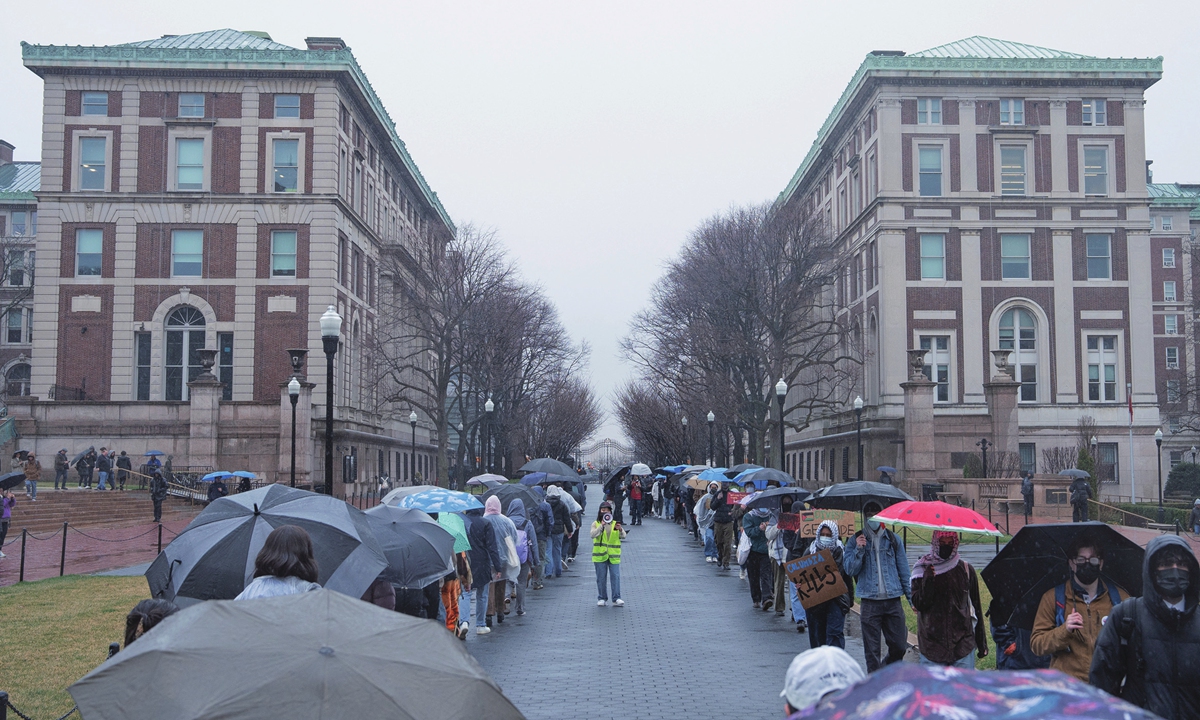
Student workers of Columbia union members protest Columbia University's recent policy changes and call for protection of international students, restoration of funding, and academic freedom at Columbia University in New York City, US, on March 24, 2025. Photo: IC

David Die Dejean is passionate about studying tuna. Last year, he landed a dream job at National Oceanic and Atmospheric Administration in Miami to pursue his research.

By January, he was settled in, had received a good review and loved working with his colleagues, he said.

Then in mid-february he received an email to vacate the premises within 90 minutes. He and hundreds others had been dismissed in job cuts targeting probationary workers as US President Donald Trump’s new administration began slashing funding for universities and research bodies.

Now Die Dejean is applying for positions in Europe.

“I want to work wherever they allow me to do the research,” said the scientist, who studies fish stocks to ensure tuna is being fished sustainably.

“I’m eagerly waiting for some of the things that are coming from the European Union... increasing the opportunities for scientists like me to come back,” said Die Dejean, who was born in Spain but has spent most of his career in the United States and Australia.

Trump’s administration says billions of dollars in cuts are needed to curb the federal deficit and bring the US debt under control.

His cutbacks on research come amid a broader clash that has seen Trump criticise universities as discriminatory for their diversity policies and denounce what he sees as a failure by some institutions to protect Jewish students from antisemitism.

The threat to academics’ livelihoods at universities including Yale, Columbia and Johns Hopkins has given Europe’s political leaders hope they could reap an intellectual windfall.

A letter, reviewed by Reuters, signed in March by 13 European countries including France, Germany and Spain, urged the EU Commission to move fast to attract academic talent.

The European Research Council, an EU body that finances scientific work, told Reuters it would double the relocation budget for funding researchers moving to the EU to €2mil (Rm10mil) per applicant. That goes towards covering the cost of moving to a European institution, which may involve setting up a laboratory.

In Germany, as part of coalition talks for a new government, conservatives and Social Democrats have drawn up plans to lure up to 1,000 researchers, according to negotiation documents from March seen by Reuters that allude to the upheaval in US higher learning.

Reuters spoke to 13 European universities and research institutes that reported seeing an increase in Us-based employees considering crossing the Atlantic, as well as half a dozen Us-based academics pondering a move to Europe.

“Regulatory uncertainty, funding cuts, immigration restrictions, and diminished international collaboration create a perfect storm for brain drain,” said Gray Mcdowell of US digital consultancy firm Capgemini Invent.

A White House official said the administration is analysing research grants and prioritising funding for areas likely to deliver returns for taxpayers “or some sort of meaningful scientific advancement”. The NOAA cuts were designed to avoid compromising its ability to do its duties, the official added.

Pulling in US talent to Europe requires more than good will though. It requires money.

For decades, Europe has lagged far behind the United States on investment in its seats of higher learning. Total expenditure on research and development in the EU among businesses, governments, universities and private non-profit organisations in 2023 was €381bil, according to the latest figures by Eurostat – the statistical office of the European Union.

That same year, total research and experimental development in the United States was estimated at Us$940bil, according to the National Center for Science and Engineering Statistics, a federal agency that provides data on the performance of science and engineering in the United States.

And while the US’S richest university, Harvard, has an endowment worth Us$53.2bil that of Britain’s wealthiest, Oxford, is only £8.3bil.

One academic and an expert in academia said, even with a concerted and substantial effort, Europe would likely need a long time to overturn that spending advantage.

The White House official said even with the cuts, the United States would still account for the most global research funding, adding: “Europe is not going to and cannot fill the void.”

Dozens of scientists have taken to social media encouraging peers to stay in the United States, while others acknowledge a number of drawbacks may deter them from moving.

Michael Olesen, director of an infection prevention programme for a healthcare system in Washington, said language barriers were one potential drawback, as were unfamiliar laws and employment practices.

Salary is another. “My impression is that I would get paid a lot less as an anaesthesiologist in Europe,” said Holden K. Groves, an Assistant Professor of Anaesthesiology at Columbia University, which received funding from the National Institutes of Health (NIH). “It’s a huge ordeal to change.”

Still, Europe’s political leaders feel the stance of the Trump administration has put the wind in their sails.

“The American government is currently using brute force against the universities in the United States, so that researchers from America are now contacting Europe,” Germany’s chancellor-in-waiting, Friedrich Merz, said this month.

“This is a huge opportunity for us.” John Tuthill, a American neuroscience professor at the University of Washington in Seattle, is assessing his options.

He cannot apply for new funding to plan beyond 2027 because grant applications have now been frozen.

The lab of 17 people he runs gets about three-quarters of its funding from the NIH, where the Trump administration has earmarked major cuts.

“Europe is the obvious one, because it is the other hub of biomedical research in the world,” said Tuthill, adding he is weighing up a move with his wife and daughter.

Aix Marseille University in France said it had received interest from 120 researchers at institutions in the United States, including NASA and Stanford, for a €15mil “safe space for science” programme launched on March 7. The initiative aims to attract US staff from fields including health, LGBT+ medicine, epidemiology and climate change.

“Our colleagues were frightened... It was our duty to rise to the occasion,” university director Eric Berton said, noting 10 European universities have contacted him about launching similar programmes.

In the Netherlands, the government wants to establish a fund to attract top foreign scientists and bolster the EU’S ‘strategic autonomy’ aims, Education Minister Eppo Bruins said in a letter.

That marks a policy shift as the government had previously announced plans to cut half a billion euros in research and higher education.

Eindhoven Tech University President Robert-jan Smits told Reuters that bringing in US scientists could boost Europe’s technological sovereignty in areas like semiconductors.

Belgium’s sister universities Vrije Universiteit Brussel and Universite Libre de Bruxelles have launched a scheme encouraging Us-based researchers to apply for 36 postdoctoral positions. And the Alexander von Humboldt Foundation, which promotes the exchange of top scientists to Germany, plans to increase its programmes by about 20%.

The Grantham Institute at Imperial College London, which specialises in climate change research, is creating at least two more research fellowship posts for early-career climate researchers from the United States and has already seen an clear uptick in applications, said its Director of Research, Joeri Rogelj..- Reuters

America First,' science on the sidelines?: US-China ...


OPINION / VIEWPOINT
‘America First,’ science on the sidelines?: US-China-Europe expert dialogue
Published: Apr 24, 2025 10:28 PM
Student workers of Columbia union members protest Columbia University's recent policy changes and call for protection of international students, restoration of funding, and academic freedom at Columbia University in New York City, US, on March 24, 2025. Photo: IC

Student workers of Columbia union members protest Columbia University's recent policy changes and call for protection of international students, restoration of funding, and academic freedom at Columbia University in New York City, US, on March 24, 2025. Photo: IC


Editor's Note:


In recent years, the US has faced unprecedented challenges to its ability to attract top global talent. The "brain drain" in the field of scientific research has been frequently discussed in the media and academia, especially under the current US administration's "America First" policy. The Global Times brings together three experts from China, the US and Europe to discuss how Washington's policy is driving away scientists and its impact on the US' research ecosystem, global talent mobility as well as the future of the global competition in scientific research.

Anthony Moretti, associate professor at the Department of Communication and Organizational Leadership at Robert Morris University

History reminds us that one reason to account for America's prestigious position in areas such as science is that it consistently opened its arms to researchers across the world. Likewise, immigration policies that welcomed such scholars ensured that the US benefited from intellectual firepower whether it was created at home or brought in from elsewhere. Now, America risks suffering from brain drain.

How is it possible that the US, the mythical land of the free, is now a place some scholars want to flee?

Through its insistence that too many colleges and universities are dedicated to "woke" policies and practices and its equally corrosive threats to take away critical grant money, the administration is making it harder and harder for researchers at America's most exceptional institutions to do their jobs. Those with the scholarship or research records that allow them to consider non-US universities are looking elsewhere. Why risk watching decades of work be destroyed?

Many scholars look at the federal government's determination to deport foreign-born graduate students and cannot help but wonder if faculty will be next. Granted, the courts might step in and make it harder for the government to kick international graduate students out of the country. But who could blame a foreign-born researcher for thinking that the courts could decide instead to endorse the president's plans? Why risk deportation?

Do enough people in Washington, and more specifically at the White House, understand the ramifications of losing some of the most intelligent people currently living in the country? US citizens are often told that their country's freedoms explain why millions of people, including the most educated, from across the globe want to live and work in America. That story now rings hollow. Over the past few decades, the US built the largest innovation engine the world has ever seen, but that engine risks short-circuiting.


Li Zheng, research fellow at the Institute of American Studies, China Institutes of Contemporary International Relations

In the post-World War II era, the US built an unrivaled innovation system with its open policies and abundant funding, attracting top talents from around the world. However, this long-standing position is being challenged as recent "America First" policies have created obstacles to continued progress.

For a long time, the US innovation system has been highly dependent on government strategic guidance, diverse teams and overseas scientists. The government has guided the scientific research system through many organizations, such as the National Institutes of Health (NIH) and the National Science Foundation, to explore the best path. The relative transcendence and independence of scientific research institutions also allow scientists to focus their own research areas and make freer choices. Besides, foreign scientists have been the mainstay of the US innovation system, allowing it to continue to gather the world's best talents.

However, the current US administration's science policy has brought harm to the US science, technology and innovation system in three ways. First, research and development funding has shrunk dramatically, with many scientific research organizations being the focus of budget cuts and layoffs. Second, the research climate in the country has been politicized. Third, the US has become more inward-looking and xenophobic in terms of scientific and technological exchanges.

Together, these have put the US science, technology and innovation system at risk of a historic setback. As the US risks losing its researchers more and more, the world isn't stopping. Europe and Canada are welcoming US scientists who want to run away from the country with open arms. Thirteen European governments asked the EU to welcome "brilliant talents from abroad who might suffer from research interference and ill-motivated and brutal funding cuts," while Canada has already become the destination for US scientists who have been laid off and are considering running away. Washington's decision to move against the science and technological development has also given more Asian countries a chance to catch up. China, South Korea and Singapore are investing more in R&D and building world-class research infrastructures. These countries may replace the US as a pole of global science and technology innovation in the future.


Sebastian Contin Trillo-Figueroa, a geopolitics analyst from Spain with a specialization in EU-Asia relations

The Trump administration's policies toward science have researchers witness a core civil right vanishing at speed. As a result, many conclude their work is at risk; and that they could pursue it more freely elsewhere.

Yet it's important to recognize that US researchers remain the best-paid in the world, with access to unmatched research funding. Their decision to leave, despite such advantages, underscores the scale of discontent.

This could have a severe negative effect on the US' scientific and tech development and innovation. First, US scientific leadership is now exposed to internal political turbulence in a way not seen before. Second, allies may begin to sever their reliance on US-based research, while the erosion of institutions like NIH weakens US influence in global science diplomacy. Third, the US may serve as a cautionary tale, demonstrating how easy it is to lose global talent, rather than attract it.

The deeper concern for the US may not be technological decline alone, but a fracture between national identity and its scientific community. Researchers, like many immigrants today, may come to believe the so-called American Dream no longer exists.

The outflow of US-based scientists redistributes knowledge and dilutes American dominance over global research. However, the loss of disillusioned US-based scientists is a net gain elsewhere. The weakening of US research leadership opens space for Europe and Asia to expand their scientific influence. Europe is well-positioned to absorb this shift, drawing on institutional infrastructure, transnational networks, and appeal as a space offering welfare protection and a high quality of life.

While Europe may lead in regulation-intensive fields, Asia - driven by China, India and regional innovation hubs - can pursue development-focused models anchored in long-term planning and state-backed research. China, in particular, may use the opening to advance its own scientific models, supported by large-scale investments and increasingly competitive conditions for high-skilled migrants. If China capitalizes on this exodus, it could absorb much of this talent - and, in doing so, tilt global scientific leadership.

The influx of US-trained scientists becomes not only a boost to research excellence, but a lever for reordering global hierarchies of expertise. Institutional responses across Europe and Asia should be strategic. Talent absorption feeds national innovation strategies and enhances soft power. For instance, China may scale up various initiatives with greater flexibility, aiming to capture expertise while managing reputational risks.


Trump’s tariff fight with Xi reveals China’s great divide


Going strong: China has become less reliant on American consumers since Trump’s first trade war in 2018. — Reuters

HOW does an escalating US-China trade war affect people’s well-being? In China, it depends on who you ask.

Some are energised by the fight. Electric-vehicle makers are in hyperdrive, pushing out luxury new models, self-driving features and battery-charging technologies that allow drivers to recharge almost as fast as filling a petrol tank. Instead of selling cars to Americans, the likes of BYD are taking on Tesla in growth regions such as South-east Asia.

There’s also talk of an “engineer dividend” – credit to President Xi Jinping for his focus on higher education in sciences. The success of DeepSeek’s reasoning model, released in late January, gave rise to a realisation that China is not just a manufacturing powerhouse whose status is being challenged by President Donald Trump’s tariffs. Rather, Beijing may have found a fresh growth model. It can grab market share in software services, which the US excels at. Almost every week, Chinese tech firms have been releasing new artificial intelligence models and applications.

In part because of a stock market rebound, luxury home sales in Shanghai are booming. Property markets in tech hubs such as Hangzhou and Shenzhen are also seeing a revival, a welcoming reprieve after a four-year downturn.

After all, China has become less reliant on American consumers since Trump’s first trade war in 2018. Exports to the US accounted for just 15% of the total in 2024, versus 20% a decade earlier. The economy will shrink by only about 3%, even if the entire trading route to the US gets wiped out.

Beneath that stoic defiance, however, are genuine concerns about how to make a living, especially among blue-collar workers. A decline in exports, until now a rare bright spot in an otherwise anaemic economy, will only create more competition for low-skilled jobs. Already, demand for their labour is diminishing due to factory automation and the end of a decade-long property boom. In 2024, the manufacturing and construction sectors absorbed just over 40% of migrant workers, versus more than half a decade earlier.

Apparel is the third-largest category of US imports from China, after communication devices and electronic equipment. On average, the textile industry hires more than 25 people for every one million yuan (RM589, 846) in gross domestic product generated. About 16 million jobs could be lost thanks to Trump’s tariffs, according to Goldman Sachs Group estimates.

What these displaced might do next matters to the rest of the 425 million-strong blue-collar workforce. In recent years, people have been moving in droves into the gig economy, working as housekeepers, drivers, delivery workers and social media influencers.

Already, some of these sectors are getting crowded. In 2024, the number of ride-hailing drivers jumped by 27% to 38 million, prompting some local governments to warn about overcapacity. No surprise, their average monthly pay fell.

Or consider the 18 million social media live streamers, often young people who want glamour in their work. Most of them aren’t getting rich – they are barely getting by. A recent academic survey shows that 93% make less than 3,000 yuan a month, not even half of what an average delivery person earns.

It’s unlikely Beijing will launch the kind of bazooka stimulus witnessed in the aftermath of the global financial crisis (GFC), the last time China’s exports registered double-digit declines. Back then, more than a third of migrant workers, or over 80 million, were employed in manufacturing. The magnitude of job losses was much larger.

Barring mass street protests, the government’s attitude towards blue-collar labourers has been that since many have few skills, they can be flexible. Manufacturing jobs gone? No problem, they can go into the services sector, or back home to the farm. During the GFC, at least 20 million laid-off migrant workers returned to rural areas. This attitude is unlikely to change just because of Trump.

In fact, this trade war only exacerbates a separation of the elite from the grassroots. For the skilled and well-to-do, US tariffs barely touch their lives, and they are thinking of new money-making opportunities now that Trump is tearing up the existing world order (Gold, anyone?). But millions of others are only getting more anxious. – Bloomberg Opinion/TNS

by Shuli Ren, a Bloomberg Opinion columnist covering Asian markets.

Related posts"

US economy in Q1 shrinks amid new tariff policies; US reportedly actively engaging with China through multiple channels