While the us continues to engage in more violent conflict abroad, china routinely plans for better quality growth and development.
BUNN NAGARA Bunn Nagara is director and senior fellow at the Renaissance Strategic Research Institute, and honorary fellow at the Perak Academy. The views expressed here are solely the writer’s own.
8 Mar 2026
Shaping the future
While the us continues to engage in more violent conflict abroad, china routinely plans for better quality growth and development.
BUNN NAGARA Bunn Nagara is director and senior fellow at the Renaissance Strategic Research Institute, and honorary fellow at the Perak Academy. The views expressed here are solely the writer’s own.
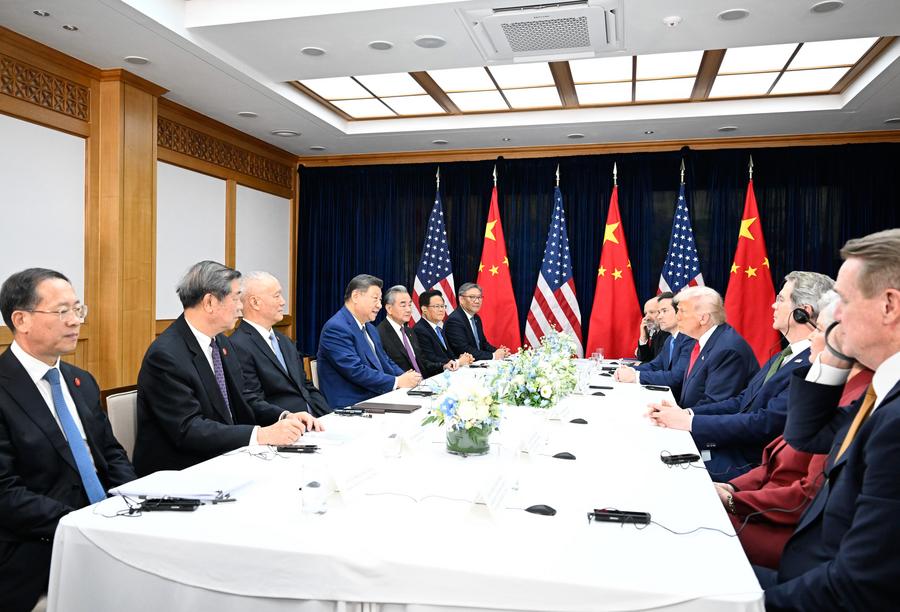
Chinese President Xi Jinping meets with U.S. President Donald Trump in Busan, South Korea, Oct. 30, 2025. (Xinhua/Huang JBy Xinhuaingwen)
Chinese President Xi Jinping said here Thursday that he is ready to continue working with U.S. President Donald Trump to build a solid foundation for bilateral ties, and create a sound atmosphere for the development of both countries.
In a meeting with Trump, Xi said under their joint guidance, China-U.S. relations have remained stable on the whole.
"China and the United States should be partners and friends. That is what history has taught us and what reality needs," he said.
Given different national conditions, the two sides do not always see eye to eye with each other, and it is normal for the two leading economies of the world to have frictions now and then, Xi added.
"You and I are at the helm of China-U.S. relations," said Xi. "In the face of winds, waves and challenges, we should stay the right course, navigate through the complex landscape, and ensure the steady sailing forward of the giant ship of China-U.S. relations."
Xi said that there is a good momentum in China's economic development, adding that in the first three quarters of this year, China's economy increased by 5.2 percent, and import and export trade in goods with the rest of the world expanded by 4 percent.
This is not an easy accomplishment given the domestic and external difficulties, Xi noted, adding that the Chinese economy is like a vast ocean, big, resilient and promising.
"We have the confidence and capability to navigate all kinds of risks and challenges," Xi added.
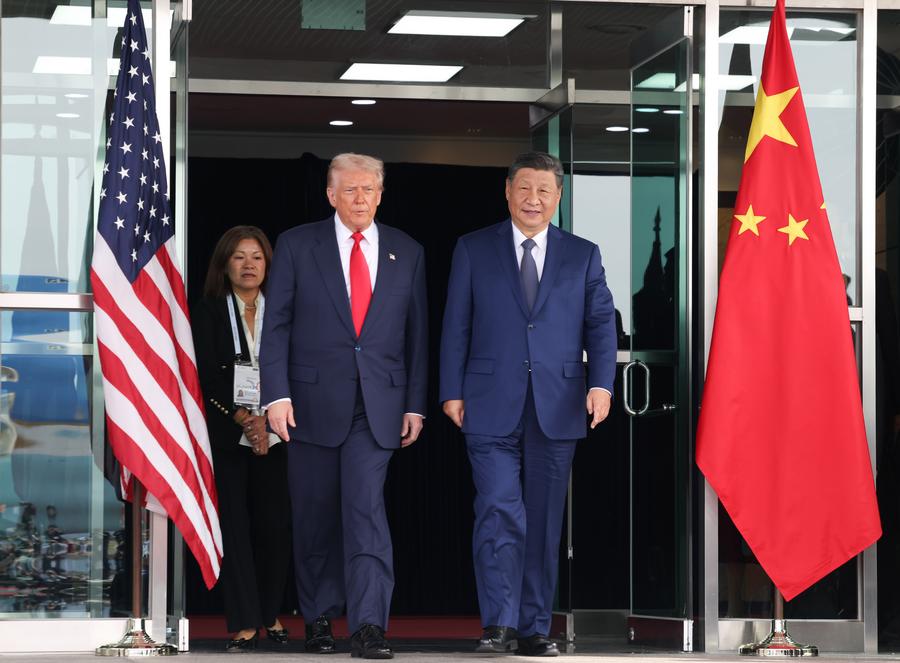
Chinese President Xi Jinping meets with U.S. President Donald Trump in Busan, South Korea, Oct. 30, 2025. (Xinhua/Shen Hong)
At its fourth plenary session, the 20th CPC Central Committee deliberated over and adopted the recommendations for the economic and social development plan over the next five years, Xi said.
"Over the past seven decades and more, we have been working from generation to generation on the same blueprint to make it a reality. We have no intention to challenge or supplant anyone. Our focus has always been on managing China's own affairs well, improving ourselves, and sharing development opportunities with all countries across the world," he added.
Describing that as an important secret to China's success, Xi said China will further deepen reform across the board, expand opening up, and promote higher-quality economic growth while achieving an appropriate increase in economic output, and advance well-rounded human development and common prosperity for all, adding that this will also expand the space for cooperation between China and the United States.
Xi noted that the two countries' economic and trade teams had an in-depth exchange of views on important economic and trade issues, and reached consensus on solving various issues.
He called on the two teams to work out and finalize the follow-up steps as soon as possible, and ensure that the common understandings are effectively upheld and implemented, to inject confidence into the two countries as well as the global economy through solid deliverables.
China-U.S. economic and trade relations have experienced ups and downs recently, and this has also given the two sides some insights, Xi noted.
The business relationship, Xi said, should continue to serve as the anchor and driving force for China-U.S. relations, not a stumbling block or a point of friction.
The two sides should think big and recognize the long-term benefit of cooperation, and must not fall into a vicious cycle of mutual retaliation, he added, calling on the two teams to continue their talks in the spirit of equality, mutual respect and mutual benefit, and continuously shorten the list of problems and lengthen the list of cooperation.
Dialogue is better than confrontation, Xi said, adding that China and the United States should maintain communication through various channels and at various levels to enhance mutual understanding.
There is good potential for the two countries to work together on combating illegal immigration and telecom fraud, anti-money laundering, artificial intelligence, and responding to infectious diseases, he added.
The competent departments should strengthen dialogue and exchanges and carry out mutually beneficial cooperation, Xi said, adding that the two countries should also engage in positive interactions on regional and international platforms.
"The world today is confronted with many tough problems. China and the United States can jointly shoulder our responsibility as major countries, and work together to accomplish more great and concrete things for the good of our two countries and the whole world," he added.
China will host APEC 2026, and the United States the G20 summit next year, Xi noted.
The two sides can support each other in making both summits productive to promote world economic growth and improve global economic governance, he added.
Chinese President Xi Jinping meets with U.S. President Donald Trump in Busan, South Korea, Oct. 30, 2025. (Xinhua/Huang Jingwen)
Noting that it was a great honor to meet with Xi, Trump said China is a great country and President Xi is a well respected great leader, with whom he has been good friends for many years and has always got along well.
The United States and China have always had a fantastic relationship, and it will be even better, said Trump, voicing his hope for an even better future for both China and the United States.
China is the biggest partner of the United States, and with joint efforts, the two countries can get many great things done for the world and have many years of success, said Trump.
China will host the 2026 APEC Economic Leaders' Meeting, while the United States will host the G20 Summit next year, said Trump, wishing both sides every success in these important events.
The two presidents have agreed to enhance cooperation in economic, trade, energy and other fields and to encourage more people-to-people exchanges.
They have also agreed to maintain interactions on a regular basis. Trump looked forward to visiting China early next year, and invited President Xi to visit the United States.
Against the backdrop of global economic uncertainty, rising protectionism and accelerated technological transformation, how should we write "Asia-Pacific's tomorrow"? "Chinese wisdom" and "Chinese solutions" have become one of the focal points of attention at this APEC meeting.
Hundreds of protesters took to the streets of Kuala Lumpur where U.S. President Donald Trump is expected to arrive for the ASEAN Summit, triggering widespread outrage over his stance on Gaza and U.S. support for Israel. Led by Malaysia’s Islamist PAS party, demonstrators waved Palestinian flags and chanted anti-Trump slogans outside the U.S. Embassy and summit venues. Riot police were deployed across the city as tensions flared, though Prime Minister Anwar Ibrahim urged protesters to remain peaceful.
The demonstrations underscored growing anger across Southeast Asia toward Washington’s Middle East policy. Despite the chaos, Trump’s visit marks the first time a U.S. president has visited Malaysia in a decade, the last being Barack Obama in 2015.
#TrumpASEANSummit#MalaysiaProtests#GazaWar#AnwarIbrahim#ASEAN2025#TrumpInAsia
India Today Global is an India-based news channel that serves as an international arm of India's prominent media organization. It aims to provide factual, up-to-date news, analysis, and insights from India and around the world. The channel delivers a mix of content, including political news, business updates, entertainment, and cultural stories, focusing on both India-centric news and broader global issues.
India Today Global features expert commentary, interviews, and in-depth reporting on key developments in India, as well as how they intersect with global events. It is known for its reputation as a trusted source of news in India. India Today Global is designed to cater to the Indian diaspora in the US while also appealing to international viewers interested in South Asian affairs and perspectives on global news.
It's the English news brand that understands and fits perfectly into the digital-first lifestyles of our English news audiences.
The marquee shows of our channel are:
Statecraft: Our Executive Editor Geeta Mohan decodes the truth, cut out the noise, and present you the real facts that shape your world. We'll dissect the narratives spun by competing interests, analyze the subtle shifts in geopolitical landscapes, and illuminate the underlying forces that drive international relations. Expect rigorous analysis, informed perspectives, and a commitment to clarity in a world often obscured by deliberate ambiguity. We'll explore the economic levers, the military strategies, and the cultural influences that intertwine to form the complex tapestry of global power. Join us as we navigate the corridors of influence and reveal the hidden mechanisms that govern our interconnected world.
Threadbare: We dive deep into global politics to unwind myths and expose false narratives shaping the world. Our episodes tackle disinformation, political information, and geopolitical myths to provide fact-based insights. Stay informed with in-depth analysis on international relations, political crisis, and global events. If you're interested in debunking political myths, exploring truth behind media narratives, and understanding the real forces driving global politics, this playlist is for you!
A draft resolution on promoting and protecting economic, social and cultural rights within the context of addressing inequalities was adopted without a vote at the 60th session of the UN Human Rights Council on Monday.
The draft resolution was submitted by China on behalf of nearly 70 countries, including Bolivia, Egypt, Pakistan, and South Africa, according to CCTV News.
Chinese Ambassador Chen Xu, China's permanent representative to the UN Office in Geneva and other international organizations in Switzerland, said at the session that as this year marks the 80th anniversary of the founding of the UN and the 30th anniversary of the adoption of the Beijing Declaration and Platform for Action, China's proposal aims to bridge differences, build consensus and focus on action-oriented cooperation, CCTV News reported.
He called for strengthening multilateralism and international cooperation, holding thematic discussions and interactive dialogues within the Human Rights Council, supporting the Office of the High Commissioner for Human Rights in enhancing its work on economic, social and cultural rights, and making full use of the economic social and cultural rights knowledge hub established under a China-tabled resolution to better provide technical assistance and capacity-building for countries in need.
Various developing countries voiced support, saying the resolution reflects the real needs of people and effectively responds to the strong calls of developing countries for increasing investment in economic, social and cultural rights. Various parties including the EU commended the resolution. After its adoption, many countries and the Office of the High Commissioner for Human Rights extended congratulations to the Chinese mission, recognizing China's leading role in advancing these rights globally, according to CCTV News.
In Anwar’s speech during President Xi Jinping’s visit to Malaysia earlier this year, he praised China as a rational, steady, and reliable partner amid the turbulence of “economic tribalism” and threats to multilateralism and the rules-based order. Last year, when Anwar spoke off-the-cuff at a business luncheon in honour of Premier Li Qiang in Kuala Lumpur, he commended the attitude of the Chinese leadership as “friendly, courteous, full of respect, [and] understanding of cultures and differences”, in contrast to the “narrative from the others” and the “barrage of questions” from others – especially “the western” – on whether Malaysia’s close relations with China would be in Malaysia’s best interest.
Understandably, as an independent nation, no country appreciates being told who it should be friends with, especially when those doing the lecturing neither act as they preach nor have been reliable friends in the first place.
While closer relations with the United States would still serve Malaysia’s interests – particularly in the realms of the economy and defence – they are proving even more elusive under President Donald Trump. His arbitrary tariff impositions, aggressive rhetoric (even against allies), withdrawals from multilateral organisations, disregard for the rule of law, undermining of the global order, and coddling of Israel have been obstacles for Malaysian leaders in promoting closer ties with the United States. Domestically, various opinion polls in recent years have shown a steady decline in Malaysians’ favourable perceptions towards the United States, while favourable views of China and even Russia have increased significantly.
If the above trend persists, Malaysia might find itself moving even further away from its non-aligned, neutral, and equidistant stances that served it well in the past. At present, however, the actions of the great powers leave little room for Malaysia to manoeuvre, and siding with the more predictable and reliable power seems to be the less risky option.
In Anwar’s speech during President Xi Jinping’s visit to Malaysia earlier this year, he praised China as a rational, steady, and reliable partner amid the turbulence of “economic tribalism” and threats to multilateralism and the rules-based order. Last year, when Anwar spoke off-the-cuff at a business luncheon in honour of Premier Li Qiang in Kuala Lumpur, he commended the attitude of the Chinese leadership as “friendly, courteous, full of respect, [and] understanding of cultures and differences”, in contrast to the “narrative from the others” and the “barrage of questions” from others – especially “the western” – on whether Malaysia’s close relations with China would be in Malaysia’s best interest.
Understandably, as an independent nation, no country appreciates being told who it should be friends with, especially when those doing the lecturing neither act as they preach nor have been reliable friends in the first place.
While closer relations with the United States would still serve Malaysia’s interests – particularly in the realms of the economy and defence – they are proving even more elusive under President Donald Trump. His arbitrary tariff impositions, aggressive rhetoric (even against allies), withdrawals from multilateral organisations, disregard for the rule of law, undermining of the global order, and coddling of Israel have been obstacles for Malaysian leaders in promoting closer ties with the United States. Domestically, various opinion polls in recent years have shown a steady decline in Malaysians’ favourable perceptions towards the United States, while favourable views of China and even Russia have increased significantly.
If the above trend persists, Malaysia might find itself moving even further away from its non-aligned, neutral, and equidistant stances that served it well in the past. At present, however, the actions of the great powers leave little room for Malaysia to manoeuvre, and siding with the more predictable and reliable power seems to be the less risky option.



 Malaysian Prime Minister Anwar Ibrahim during a parade for Malaysian Independence Day celebrations last month in Putrajaya, Malaysia (Syaiful Redzuan/Anadolu via Getty Images