Share This

Showing posts with label eating. Show all posts

Wednesday, 15 July 2026

Here's how to dine on durian wisely

 It’s hard to stop at just a few pieces of durian, but if you keep going, it can easily add up to another entire meal’s worth of calories. — LIM BENG TATT/The Star 

Two durian pieces fine, 15 equal to a meal, says dietitian

When durian season arrives, many Malaysians do not eat durian like fruit, they consume it like a feast.

If six apples were placed on the table, most people would not finish all six at one sitting.

The same goes for eight oranges or 10 bananas, for example.

But when it comes to durian, “just one more piece” can easily become 10, 15, or even 20 pieces (or seeds), before anyone realises it.

The issue is not that durian is “bad”. The real issue is portion size.

After 15 pieces

A recent personal observation using a continuous glucose monitor (CGM) showed how much portion size can matter.

A CGM is a small sensor that tracks glucose levels throughout the day.

Before eating the durian, the glucose reading was 4.9 mmol/L.

After consuming 15 pieces of durian, the reading rose to 8.0 mmol/L within an hour.

It peaked at 9.1 mmol/L after about 90 minutes before gradually coming down over the next few hours.

If blood glucose had only been checked before eating and two hours after eating, the result may not have looked alarming.

But the CGM showed the full journey: how high the glucose climbed, how long it stayed elevated, and how much work the body had to do to bring it back down.

This was only an individual observation, not a clinical study, and glucose response can differ from person to person.

However, it is a useful reminder that blood glucose response is not only about the type of food we eat, but also about the total portion we consume.

The glucose did not rise because of one piece; every extra piece contributed to the total glucose load the body had to manage.

Each piece of durian adds more carbohydrate for the body to process.

The body then releases insulin to help move glucose from the bloodstream into the muscles and liver to be used or stored as energy.

When calorie intake repeatedly exceeds what the body needs, the excess energy may contribute to weight gain over time.

Every additional piece means more glucose to manage, more insulin to release and more calories to handle.

Durian nutrients

An average piece of durian, weighing about 27g, contains approximately 45 kcal and 8g of carbohydrate.

At the same time, durian also provides dietary fibre, potassium, vitamins B and C, and beneficial antioxidants.

In other words, durian is still a fruit that provides good nutrients.

Like every other fruit, it has a recommended serving size.

Malaysians are generally encouraged to consume two servings of fruit daily, and durian can fit into this recommendation when eaten in the right portion.

For example, one serving of fruit looks like this:

  • One medium apple
  • One small banana
  • One medium orange
  • One slice of papaya
  • Two average-sized pieces of durian.

Two average-sized pieces of durian provide about 90 kcal and 16g of carbohydrates.

This can still be considered a moderate-sized snack portion.

That is why two average-sized pieces of durian can be considered one serving of fruit.

‘Just one more piece’
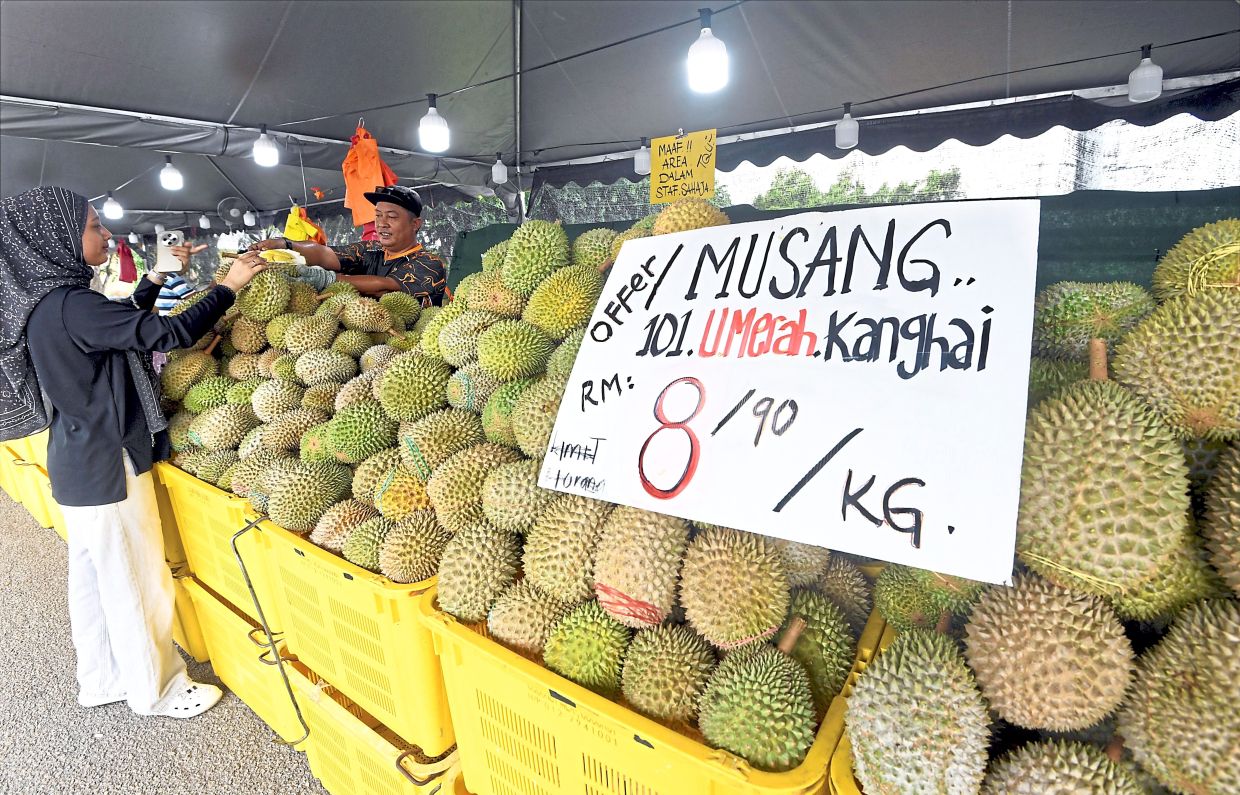
The current cheaper prices of durian makes it even harder to limit consumption for durian lovers. — AZHAR MAHFOF/The Star

The problem is not consuming the two pieces of durian; the problem is that durian is rarely limited to just two pieces.

Below are the amount of calories and carbohydrates for different amounts of durian:

  • One piece: 45 kcal and 8g
  • Five pieces: 225 kcal and 40g
  • 10 pieces: 450 kcal and 80g
  • 15 pieces: 675 kcal and 120g.

For comparison, a typical Malaysian lunch or dinner may provide around 500 kcal and 60g of carbohydrate, depending on food choices and portion size.

Now, imagine enjoying 10, or even 15, pieces of durian.

Without realising it, those “just one more piece” moments can quietly add another entire meal’s worth of calories and carbohydrates to your daily food intake.

Durian is generally considered a low to medium glycaemic index (GI) fruit.

Because of this, some people may assume it can be eaten freely.

ALSO READ: Understanding the glycaemic index

However, the glycaemic index of a food is only one part of the picture.

The bigger concern during durian season is glycaemic load, which refers to the total amount of carbohydrates consumed.

One or two pieces may be manageable for many people.

But 10 or 15 pieces create a much higher glucose load for the body to manage.

This is especially important for people living with diabetes, prediabetes, insulin resistance, weight concerns or a family history of diabetes.

Eat wisely

Still, Malaysians do not need to avoid durian completely.

Food should not be about fear; durian can still be enjoyed.

The key is to enjoy it with better awareness and a more mindful portion, especially when it is eaten after a full meal:

  • Keep to about two average- sized pieces as one fruit serving.
  • Avoid eating a large amount of durian immediately after a heavy rice-based meal.
  • Share with family or friends instead of finishing one box or fruit alone.
  • Eat slowly and enjoy the taste, instead of turning it into a challenge.

For people with diabetes, prediabetes or other health concerns, monitoring your blood glucose response and seeking personalised advice from a dietitian or healthcare professional can help support better food choices.

Durian season is something many Malaysians look forward to.

The goal is not to stop people from enjoying durian, but to help everyone enjoy it with better awareness.

Khoo Wei Jin is a dietitian at Alpro Pharmacy. For more information, email starhealth@thestar.com.my. The information provided is for educational and communication purposes only, and should not be considered as medical advice. The Star does not give any warranty on accuracy, completeness, functionality, usefulness or other assurances as to the content appearing in this article. The Star disclaims all responsibility for any losses, damage to property or personal injury suffered directly or indirectly from reliance on such information.

Related stories:


Two durian pieces fine, 15 equal to a meal, says dietitian 

Here's how to dine on durian wisely

 It’s hard to stop at just a few pieces of durian, but if you keep going, it can easily add up to another entire meal’s worth of calories. — LIM BENG TATT/The Star 

Two durian pieces fine, 15 equal to a meal, says dietitian

When durian season arrives, many Malaysians do not eat durian like fruit, they consume it like a feast.

If six apples were placed on the table, most people would not finish all six at one sitting.

The same goes for eight oranges or 10 bananas, for example.

But when it comes to durian, “just one more piece” can easily become 10, 15, or even 20 pieces (or seeds), before anyone realises it.

The issue is not that durian is “bad”. The real issue is portion size.

After 15 pieces

A recent personal observation using a continuous glucose monitor (CGM) showed how much portion size can matter.

A CGM is a small sensor that tracks glucose levels throughout the day.

Before eating the durian, the glucose reading was 4.9 mmol/L.

After consuming 15 pieces of durian, the reading rose to 8.0 mmol/L within an hour.

It peaked at 9.1 mmol/L after about 90 minutes before gradually coming down over the next few hours.

If blood glucose had only been checked before eating and two hours after eating, the result may not have looked alarming.

But the CGM showed the full journey: how high the glucose climbed, how long it stayed elevated, and how much work the body had to do to bring it back down.

This was only an individual observation, not a clinical study, and glucose response can differ from person to person.

However, it is a useful reminder that blood glucose response is not only about the type of food we eat, but also about the total portion we consume.

The glucose did not rise because of one piece; every extra piece contributed to the total glucose load the body had to manage.

Each piece of durian adds more carbohydrate for the body to process.

The body then releases insulin to help move glucose from the bloodstream into the muscles and liver to be used or stored as energy.

When calorie intake repeatedly exceeds what the body needs, the excess energy may contribute to weight gain over time.

Every additional piece means more glucose to manage, more insulin to release and more calories to handle.

Durian nutrients

An average piece of durian, weighing about 27g, contains approximately 45 kcal and 8g of carbohydrate.

At the same time, durian also provides dietary fibre, potassium, vitamins B and C, and beneficial antioxidants.

In other words, durian is still a fruit that provides good nutrients.

Like every other fruit, it has a recommended serving size.

Malaysians are generally encouraged to consume two servings of fruit daily, and durian can fit into this recommendation when eaten in the right portion.

For example, one serving of fruit looks like this:

  • One medium apple
  • One small banana
  • One medium orange
  • One slice of papaya
  • Two average-sized pieces of durian.

Two average-sized pieces of durian provide about 90 kcal and 16g of carbohydrates.

This can still be considered a moderate-sized snack portion.

That is why two average-sized pieces of durian can be considered one serving of fruit.

‘Just one more piece’

The current cheaper prices of durian makes it even harder to limit consumption for durian lovers. — AZHAR MAHFOF/The Star

The problem is not consuming the two pieces of durian; the problem is that durian is rarely limited to just two pieces.

Below are the amount of calories and carbohydrates for different amounts of durian:

  • One piece: 45 kcal and 8g
  • Five pieces: 225 kcal and 40g
  • 10 pieces: 450 kcal and 80g
  • 15 pieces: 675 kcal and 120g.

For comparison, a typical Malaysian lunch or dinner may provide around 500 kcal and 60g of carbohydrate, depending on food choices and portion size.

Now, imagine enjoying 10, or even 15, pieces of durian.

Without realising it, those “just one more piece” moments can quietly add another entire meal’s worth of calories and carbohydrates to your daily food intake.

Durian is generally considered a low to medium glycaemic index (GI) fruit.

Because of this, some people may assume it can be eaten freely.

ALSO READ: Understanding the glycaemic index

However, the glycaemic index of a food is only one part of the picture.

The bigger concern during durian season is glycaemic load, which refers to the total amount of carbohydrates consumed.

One or two pieces may be manageable for many people.

But 10 or 15 pieces create a much higher glucose load for the body to manage.

This is especially important for people living with diabetes, prediabetes, insulin resistance, weight concerns or a family history of diabetes.

Eat wisely

Still, Malaysians do not need to avoid durian completely.

Food should not be about fear; durian can still be enjoyed.

The key is to enjoy it with better awareness and a more mindful portion, especially when it is eaten after a full meal:

  • Keep to about two average- sized pieces as one fruit serving.
  • Avoid eating a large amount of durian immediately after a heavy rice-based meal.
  • Share with family or friends instead of finishing one box or fruit alone.
  • Eat slowly and enjoy the taste, instead of turning it into a challenge.

For people with diabetes, prediabetes or other health concerns, monitoring your blood glucose response and seeking personalised advice from a dietitian or healthcare professional can help support better food choices.

Durian season is something many Malaysians look forward to.

The goal is not to stop people from enjoying durian, but to help everyone enjoy it with better awareness.

Khoo Wei Jin is a dietitian at Alpro Pharmacy. For more information, email starhealth@thestar.com.my. The information provided is for educational and communication purposes only, and should not be considered as medical advice. The Star does not give any warranty on accuracy, completeness, functionality, usefulness or other assurances as to the content appearing in this article. The Star disclaims all responsibility for any losses, damage to property or personal injury suffered directly or indirectly from reliance on such information.

Related stories:


Two durian pieces fine, 15 equal to a meal, says dietitian 

Monday, 10 July 2023

Papaya Tongue-Strengthening Exercises


Papaya Tongue-Strengthening Exercises


In the future, the new treatment method for malignant tumors is no longer chemotherapy, radiotherapy or surgery, but changing one's diet to improve the new blood vessels!

Great medical knowledge! A high-quality diet is the natural chemotherapy three times a day. The following information should be taken seriously, it is simple and easy to implement, and it is very good!

‭‭ What you may not know is: Papaya, which we usually find strange and easy to obtain, is the king of fruits! The tomato that the doctor praised was nothing compared to papaya. Papaya has been selected by WHO (World Health Organization) as the fruit with the highest nutritional value for two consecutive years, that is, the king of fruits!

The nutritional value of papaya is:

1. Calcium: papaya is 2 times that of apples.

2. Vitamin C: papaya is 13 times that of apples, 7 times that of bananas, 7 times that of watermelon, 8 times that of cherries, and 1.3 times that of pineapples.

3. Vitamin A: papaya is 10 times that of kiwi, 18 times that of apple, 1.5 times that of guava, 15 times that of banana, 1.5 times that of watermelon, 15 times that of cherries, and 16 times that of pineapple.

4. Vitamin K: papaya is 5 times that of bananas, 2.5 times that of watermelon, and 4 times that of pineapples.

Great again! related to eye protection...

5. Carotenoids, lycopene, B carotene, lutein and zeaxanthin, etc.: Papaya is 2000 times bigger than kiwi! Kiwis, apples, cherries, pineapples, bananas, guava, none of these ingredients.

Great! The above data source is the United States Department of Agriculture (USDA) 2016. —————————

TRUE STORY FROM A PATIENT :-

[Note] I have been suffering from cancer for 16 years. I have undergone chemotherapy. Some doctors told me to eat more papayas. The heart of gratitude is indescribable, I just hope that more people can benefit from it!

When you go to visit in the future, if you choose fruit as a gift, you can bring papaya!

According to a Doctor from US: After the age of 50 one may experience many types of illnesses. But the one I am most worried about is Alzheimer's.

Not only would I not be able to look after myself, but it would cause a lot of inconveinence to family member

One day, my son Sushil came home and told me that a doctor friend has taught him an exercise using the tongue.

The tongue exercise is effective to reduce the onset of Alzheimer's and is also useful to reduce / improve

*1* Body weight

*2* Hypertension

*3* Blood-Clot in Brain

*4* Asthma

*5* Far-sightedness

*6* Ear buzzing

*7* Throat infection

*8* Shoulder / Neck infection

*9* Insomia

The moves are very simple and easy to learn

Each morning, when you wash your face, in front of a mirror, do the exercise as below :

stretch out your tongue and move it to the right then to the left for 10 times

Since I started exercising my tongue daily, there was improvement in my Brain Retention.

My mind was clear and fresh and there were other improvements too...

1 Far sightedness

2 No giddiness

3. Improved wellness

4. Better digestion

5. Lesser flu / cold


I am stronger and more agile. 

The tongue exercise helps to control and prevent Alzheimer's... Medical research has found that the tongue has connection with the BIG Brain. When our body becomes old and weak, the first sign to appear is that our tongue becomes stiff and often we tend to bite ourselves.

Frequently exercising your tongue will stimulate the brain, help to reduce our thoughts from shrinking and thus achieve a healthier body.

Senior Citizens Please forward ⏯️

I encourage each person receiving this newsletter to forward it to another ten people, certainly at least one life will be saved. I've done my part, I hope you can help do your part. thanks 🙏

Can Doing This Tongue Exercise Help Prevent Alzheimer's?

PAPAYA and TONGUE EXERCISE from www.thequint.com

Soft palate and tongue exercises


7 dos and don'ts of eati


13 Side Effects Of Papaya 


8 Benefits of eating papaya


Eating Papaya On Empty Stomach: 10 Health Benefits ...


Fact Check: Post claiming tongue exercise cures ..


World Health Organization refutes claim it endorsed ...


Know the many healing properties of papaya, from ... PAPAYA and TONGUE EXERCISE from indianexpress.com