Share This

Saturday, 19 April 2025

California sues Trump administration over "unlawful tariffs


California governor Gavin Newsom announced on Wednesday that the western U.S. state which has the largest economy in the nation is suing the Trump administration over the President's sweeping "unlawful tariffs" on international trading partners.

"President Trump's unlawful tariffs are wreaking chaos on California families, businesses, and our economy - driving up prices and threatening jobs," Newsom said in a statement, adding that "We're standing up for American families who can't afford to let the chaos continue."

"Donald Trump does not have the authority to impose these destructive and chaotic tariffs. America stands to lose too much," said the governor in a post on X platform.

"We're taking him to court," said the governor.

"California is the largest manufacturing state in our union, one of the largest trading partners around the globe. No state will be impacted more than the state of California as it relates to the unilateral authority that's been asserted by the Trump administration to impose the largest tax increases in modern American history," he noted.

Newsom pointed out that "In America, forty percent of goods movements in this country come through two ports of entry in California. About 50 percent of that from China itself."

In the lawsuit, expected to be filed in the U.S. District Court for the Northern District of California, California officials will argue that the law, known as the International Emergency Economic Powers Act, which Trump cited to impose the tariffs, does not grant him the ability to unilaterally adopt those tariffs.

California, also the most populated U.S. state, is the first state in the nation to sue Trump administration on tariffs.

The Golden State is the largest importer among all U.S. states, with more than 675 billion U.S. dollars in two-way trade supporting millions of jobs throughout the state. Mexico, Canada and China are California's top three export destinations, buying nearly 67 billion dollars in California exports, which was over one-third of the state's 183 billion dollars in exported goods in 2024, according to the data released by the governor's office. - Xinhua

31 MOUs inked will deepen M'sia-China growth, say trade groups


“It further signals China’s readi­ness to work closely with regional partners like Malaysia to promote stability and shared prosperity in an increasingly complex global landscape,” he said when contacted yesterday.

ALSO READ: Despite challenges, Malaysia pledges to solidify trust, communication with China

Lauding the MOUs, Soh said it was important to take things beyond just the trade volume and investment ­figures.

“It must focus on co-creating high-value industrial ecosystems that support both countries’ aspirations, aligning Malaysia’s New Industrial Master Plan 2030 (NIMP2030) with China’s innovation-­driven growth agenda,” he said.

Citing significant potential in strategic sectors such as advanced manufacturing, clean and renewable energy, electric mobility, artificial intelligence, biotechnology and smart logistics, Soh said the collaboration would spur both nations to jointly develop high-impact projects and sustainable, value-added supply chains.

He suggested that a more structured bilateral cooperation ­mechanism between both govern­ments and the business community be set up, such as joint innovation hubs and green and digital industrial parks.

ALSO READ: Synergy between two nations

Such an arrangement would further enhance Malaysia as a strategic base for Chinese ­investors to tap into Asean and the regional market via the Regional Comprehensive Econo­mic Part­nership (RCEP) and ACFTA.

Associated Chinese Chambers of Commerce and Industry Malaysia (ACCCIM) treasurer-­general Datuk Koong Lin Loong said the deepening cooperation went beyond China’s Belt and Road Initiative (BRI) as it covered several other key sectors.

He said the upgrading of the Malaysia-China Kuantan Industrial Park (MCKIP) under the “Two Countries, Twin Parks” initiative should also include the setting up of similar parks in other parts of the country.

Koong stated that collaboration aimed at enhancing inspection protocols for items such as fresh coconuts and standardising regulations could facilitate increased agricultural exports to China.

Small and Medium Enterprises Association Malaysia (Samenta) national president Datuk William Ng said the wide-ranging agreements marked a promising new era in Malaysia-China relations.

“I see this as a pivotal moment for Malaysian businesses, especially our SMEs. The sectors identified in the MOUs reflect where the future of trade and industry is heading,” he said.

Ng said the benefits of the strategic partnerships must be inclusive and accessible to local SMEs, which he said made up over 97% of Malaysian businesses.

“We welcome these MOUs, and we want to see them benefit the SMEs and the rakyat and not just a select group of GLCs,” he added.

Ng proposed the creation of downstream programmes to enable SMEs to engage in key sectors through joint ventures, vendor development, or technology adoption.

ALSO READ: Influencer economy can be key to further growth

He said the collaboration should see Chinese companies helping local SMEs tap into the Chinese market via cross-border digital platforms, especially those operated by Chinese tech firms.

Malaysia Semiconductor Industry Association (MSIA) president Datuk Seri Wong Siew Hai said the MOUs showed a clear intent by both nations to work together in bringing prosperity to their people.

“Among the key areas of cooperation is the adoption of AI and e-commerce, where China is a global leader. If we can adopt their approach, we can accelerate the digitisation of government and the implementation of a more comprehensive digital economy for the nation,” he said.

Wong said that Malaysia would also benefit from the collaboration between the leading universities of both nations, particularly in relation to emerging technologies.

Source link


Related stories:


Related posts:


Friday, 18 April 2025

Malaysia will be China’s friend at all times, 31 MOUs inked in ‘new golden era’

PUTRAJAYA: Malaysia will remain an unwavering and principled friend to China during “moments of triumph and times of trial”, says Datuk Seri Anwar Ibrahim

The Prime Minister said Malaysia and China have long stood shoulder to shoulder – not merely as comprehensive strategic partners, but as steadfast friends.

“Malaysia values this consistency. Malaysia will remain an unwavering and principled friend to China, guided by the wisdom of history and the promise of the future,” he said in a speech during the official dinner in honour of President Xi Jinping last night.

At a time when multilateralism is under tremendous strain, as certain nations abandon the principle of shared responsibility and others question long-standing commitments, Anwar said China’s global initiatives seem to offer a new lease on hope. 

“What we are witnessing today is not an honest reckoning with the imperfections of globalisation, but a retreat into economic tribalism. 

“Market access is being wea­ponised. What was once a multilateral covenant for shared growth now buckles under the weight of arbitrary disruption and unilateral whim.

“Amid this turbulence, China has been a rational, strong and reliable partner,” he said

Anwar said Malaysia’s foreign policy was shaped by a “clear-eyed” vision of its interest and the principle of Asean centrality.

“We do not simply favour coope­ration over confrontation (but) we embrace it. We do not merely prefer respect over rivalry, we uphold it.

“And we choose dialogue, not simply because it chose us, but as a cornerstone of lasting peace and prosperity,” he said.

The Prime Minister said that during these trying times, the world yearns for steadiness, reliability and purpose.

“We see this in China’s conduct. Malaysia acknowledges such steadiness with quiet recognition and remains conscious not only of the calm it has brought, but of the hope it may continue to offer,” said Anwar.

He said under the leadership of Xi, China has outlined a series of global initiatives that reflect a distinctive worldview.

He said the Belt and Road Initiative reimagines connectivity not as a network of roads and rails, but as a framework for cooperation.

“The Global Development Initiative underscores the importance of inclusive progress.

“The Global Security Initiative calls for peace through dialogue,” he said.

“Each of these ideas reflects a broader aspiration of what President Xi has described as a community with a shared future for mankind. 

“This brings to mind the famous saying of Confucius, that ‘within the four seas, all men are brothers’,” added Anwar, who said the phrase in Chinese.

He said he also hoped that Malaysia and China would endure a long-lasting relationship.

Malaysia and China deepen partnership with major deals on trade, tech and tourism

PUTRAJAYA: Malaysia and China have signed 31 memoranda of understanding (MOUs), notes and cooperation agreements with the highlight being a mutual visa exemption for travellers between the two countries.

Currently, Malaysians can tra­vel to China visa-free until Dec 31 this year, while Chinese nationals enjoy visa-free travel to Malaysia until Dec 31 next year.

The exemption was in conjunction with the 50th anniversary of diplomatic relations between Malaysia and China.

Other strategic areas of coope­ration include security, development, trade, transport, agriculture, education and digital technology.

The exchange of documents, which took place at the Seri Perdana Complex yesterday, was witnessed by Prime Minister Datuk Seri Anwar Ibrahim and Chinese President Xi Jinping.

Among the key agreements signed with ministries and agencies is one concerning giant pandas, comprising an MOU on the Cooperative Research Agreement for the International Conservation of Giant Pandas.

Strategic talks: Anwar and Xi with their delegates during a bilateral meeting at the Seri Perdana Complex in Putrajaya. — AZHAR MAHFOF/The StarStrategic talks: Anwar and Xi with their delegates during a bilateral meeting at the Seri Perdana Complex in Putrajaya. — AZHAR MAHFOF/The Star

Additionally, under the Invest­ment, Trade and Industry Minis­try, three MOUs were signed, including one aimed at upgrading the China-Malaysia “Two Coun­tries, Twin Parks” initiative.

Also, three MOUs were inked under the Tourism, Arts and Culture Ministry, including tourism and media cooperation between Xinhua News Agency from China and Malaysia Tourism Promotion Board.

There was also an exchange of notes between China and Malay­sia on the establishment of a joint foreign and defence dialogue.

Under the Transport Ministry, Malaysia and China signed an MOU between the National Railway Administration of China and the Transport Ministry to strengthen cooperation in the railway sector.

Meanwhile, the Digital Ministry and China’s National Develop­ment and Reform Commission inked an MOU on the digital economy, while the Domestic Trade and Cost of Living Ministry signed an agreement on cooperation in the field of intellectual property.

Several MOUs were also signed with media groups and universities, including one on bilateral cooperation between China’s People’s Daily and Star Media Group Bhd.

At the start of a bilateral mee­ting, Anwar remarked that Malaysia remains committed to working together with China in various areas, including economy, trade, and emerging technologies such as artificial intelligence.

The Prime Minister stated that China is not only a close neighbour but also an important partner through the comprehensive strategic partnership, which reflects the deep trust and long-­standing cooperation between the two nations.

Toasting ties: Anwar and Xi attending the official dinner in honour of the Chinese President at the Seri Perdana Complex. — BernamaToasting ties: Anwar and Xi attending the official dinner in honour of the Chinese President at the Seri Perdana Complex. — Bernama

Recalling his previous visit to China, Anwar said: “As I have said to you when we met in China, President Xi exemplifies a new type of persona, a leader who talks about growth and investment and economic advancement.

“He also talks about eliminating poverty and has proven his success, more importantly about shared prosperity and civilisation, which is hardly expressed by any modern leader in this world.

“We admire your tenacity and for that Malaysians welcome you, President Xi, not only as president of a great country, the President of China, but as a true friend.”

In his remarks, Xi announced a bold and shared vision for the future of China-Malaysia relations, pledging to elevate the partnership to unprecedented strategic heights.

He said both countries are committed to forging an even stronger bond, promising mutual benefits and enhanced regional prosperity.

“This marks my return to Malaysia after 12 years, during which the nation has achieved remarkable progress in its develop­ment.

“Your Madani government is steadily becoming a promising reality, and I extend my heartfelt congratulations,” he said.

Xi recalled the pivotal establishment of diplomatic relations between China and Malaysia over five decades ago, which defied the tensions of the Cold War.

He also highlighted the solida­rity exhibited by both nations during the Covid-19 pandemic.

“Today, our two countries are working in unity to jointly build a community with a shared future. China-Malaysia relations are now entering a new golden era,” he said

Related post|:

May the Ship of China-Malaysia Friendship Sail Toward an Even Brighter Future


Related stories:


Thursday, 17 April 2025

China establishes world's first three-satellite constellation in the Earth-moon region of space; Space rescue: Chinese astro-engineers share a satellite-saving mission that spans 123 days and covers 8.5 million kilometers


Photo: VCG


Chinese President Xi Jinping will pay a state visit to Russia from May 7 to 10 and attend the celebrations marking the 80th anniversary of the Victory in the Great Patriotic War in Moscow, at the invitation of President Vladimir Putin of the Russian Federation. This year marks the 80th anniversary of the victory of the Chinese People's War of Resistance Against Japanese Aggression, the Great Patriotic War of the Soviet Union and the World Anti-Fascist War. Xi's Russia visit will not only deepen bilateral ties at the level of head-of-state diplomacy but will also hold broader significance for the world.

The international order is currently facing multiple shocks, and the underlying causes are closely linked to the erosion of the view of the World War II (WWII) history. 

The rise of unilateralism has broken with the post-war tradition of multilateral cooperation; the spread of historical revisionism has intensified the fragmentation of international norms; and the resurgence of exclusionary ideologies has led to social division. Some right-wing politicians use various means to obscure and distort the history of WWII, while others seek to gain political benefits and solidify their positions by whitewashing fascism. Even more dangerously, the flawed historical view is feeding a vicious cycle alongside geopolitical conflicts: In an attempt at containment, they denigrate - or even deny - the historical contributions of China and Russia; and in the name of a "free and open Indo-Pacific," they seek to breach the pacifist postwar constitution and resurrect military adventurism.

Against this backdrop, the joint advocacy by China and Russia to foster a right view of the WWII history, defend the outcomes of the victory in the war and the post-war international order, and uphold international fairness and justice serves as an important guiding force for maintaining world peace and stability.

The war that successfully ended 80 years ago was fundamentally a battle between justice and evil. It was a magnificent feat of the international community overcoming boundaries of nation, race, and ideology to unite against fascist aggression. From the Normandy landings in Europe to the Pacific theater in Asia, from the Battle of Stalingrad to China's brave resistance against Japanese invasion, and across Asia, Africa, and Latin America, countries joined forces in an unprecedented effort to defeat the Axis powers' imperial ambitions. This demonstrated the unparalleled power of multilateral cooperation in the face of global threats. 

We will also never forget that the victory of the Chinese People's War of Resistance Against Japanese Aggression was inseparable from the robust support of the international community. The Soviet Union's dispatch of troops to Northeast China hastened the collapse of Japanese imperialism; the US supplied China with aircraft and artillery under the Lend-Lease; and the 1943 Cairo Declaration expressly demanded that Japan return all the Chinese territories it had seized - including Taiwan. 80 years ago, the vast majority of the world's nations stood shoulder to shoulder against a common foe in pursuit of a shared ideal of peace - a fact that all humanity should remember forever.

The victory in WWII was a triumph of multilateral cooperation that transcended different systems and beliefs, overcoming fascist tyranny. This proves that the law of the jungle, where the strong prey on the weak, is not the right path for human development. It laid the foundation for an international order centered on the United Nations and gave rise to a wave of national liberation and peaceful development based on equality and self-determination among all nations. Fostering a right view of WWII history is also about defending a proper view of the international order.

The construction of the postwar international system further proved that multilateralism is not a temporary strategy in the game of great powers, but a conscious choice of civilization born from immense sacrifice. As the main theater in the East during World War II, China was not only a significant contributor to the World Anti-Fascist War but also a builder and maintainer of the post-war international order. China has always advocated the Five Principles of Peaceful Coexistence and has played a constructive role in alleviating regional crises through active diplomatic mediation. From proposing the concept of building a community with a shared future for mankind to introducing three major global initiatives, China is actively demonstrating what it means to uphold and defend a right view of WWII history. It is providing the world with a Chinese solution that transcends zero-sum games and promotes the development of the international order in a just and reasonable direction.

Standing at the crossroads of changes unseen in a century, humanity needs to learn from historical experience of WWII victory more than ever. As former German president Richard von Weizaecker said, "those who do not review history will be blind to reality." Promoting a correct understanding of World War II is inherently linked to upholding a just international order. Whether mediating regional conflicts or addressing global crises, countries must learn from history and adhere to the just principles established after the war. Only by anchoring ourselves in a correct historical perspective can humanity maintain a baseline of peace amid potential risks of de-globalization and conflict.

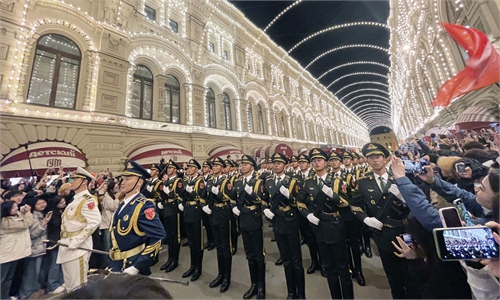
"Justice will prevail! Peace will prevail! The people will prevail!" These slogans were shouted by the Guard of Honor of the Chinese People's Liberation Army during the nighttime rehearsal for the Victory Day parade on May 9 in Moscow's Red Square, eliciting waves of cheers and applause from the audience. The three declarations of "will prevail" and the warm reception of the PLA are concrete manifestations of the appreciation and support for upholding and promoting a right view of WWII history. More people standing on the side of defending the right view of WWII history and upholding post-war international fairness and justice is the best way to commemorate the victory of the World Anti-Fascist War. - Global Times editorial

Tuesday, 15 April 2025

Telcos ordered to resolve Internet issues

DeepSeek Logo
Deepseekw https://www.deepseek.com/./深度求索

 TAPAH: Communic ations Minister Datuk Fahmi Fadzil has given all telecommunication companies until 5 pm on Sunday to submit solutions to the problem of poor Internet access nationwide, or face stern action.

Fahmi said he has contacted Malaysian Communications and Multimedia Commission (MCMC) executive chairman Tan Sri Mohamad Salim Fateh Din on Sunday morning and instructed telecommunications companies involved to respond promptly to the weak coverage feedback conveyed.

“Telecommunication companies need to be more proactive in resolving this issue. When it comes to collecting overdue bills, they’re lightning fast, but when we lodge complaints, it takes months.

“So I’ve had enough. If they fail to present swift and concrete solutions by 5 pm today, MCMC will begin enforcement action against them tomorrow,” he told reporters after visiting the National Information Dissemination Centre (NADI) in Air Kuning on Sunday.

Also present were Perak Communications, Multimedia and Non-Governmental Organisation (NGO) Committee chairman Mohd Azlan Helmi and Barisan Nasional candidate for the Ayer Kuning state byelection, Dr Mohamad Yusri

Bakir.

Fahmi said based on a drive test conducted by MCMC on March 5, many areas still fail to meet the Mandatory Standards on Quality of Service (MSQoS), which currently requires a minimum speed of 7.5 Mbps, which will be increased to 10 Mbps next year.

“The issue of Internet access is not only limited to Air Kuning, it is also affecting many other areas such as Belaga and Ulu Rajang in Sarawak, the new township of Serenia, the outskirts of Tambun, and even on Pangkor Island. Several Orang Asli villages have also been impacted,” he said.

He added that if the telecommunication companies failed to resolve the Internet access problem, they would face stricter enforcement measures, including hefty fines and penalties that could reach millions of ringgit.

“After we amended the Communications and Multimedia Act, which came into effect on Feb 11, fines and compounds that can be imposed on telcos will be significantly higher than before,” he said.

At the same time, Fahmi reminded netizens to be cautious when making statements or campaigning on social media, especially concerning the 3R issues (race, religion, royalty) during the Ayer Kuning byelection period.

“If there are individuals who upload extreme posts or 3R-related content, and are convicted in court, they may be fined up to RM500,000, compounded up to RM250,000, or face imprisonment. I hope all parties will conduct their campaigns in a responsible manner,” he said.

Fahmi said so far, no complaints have been received, but he expected campaign activities to pick up in the coming week.

When asked about Perikatan Nasional (PN) supporters using caricatures that seemingly mocked Prime Minister Datuk Seri Anwar Ibrahim and DAP secretary-general Anthony Loke, Fahmi said he was not surprised by the approach.

“If that’s how they want to campaign, so be it. That’s their way. Let us campaign based on facts, ideas, and what we can actually offer, not just insults and ridicule,” he said.- The Borneo Post (Sabah)

How to make a report to MCMC when your telco 

disappoints you 

https://malaysia.news.yahoo.com/report-mcmc-telco-disappoints-again-231249225.html