Share This

Showing posts with label National Pharmaceutical Regulatory Agency (NPRA). Show all posts

Monday, 4 May 2026

Drugstores not immune to fraud, Beware of cheap fake meds online

 Cases of stolen identity, couterfeit products
PETALING JAYA: What was first a mere question from a friend about discounted products ­quickly turned into a worrying discovery for pharmacist Rachel Gan May Shiang.

Someone was using her pharmacy’s identity to sell doubtful products.
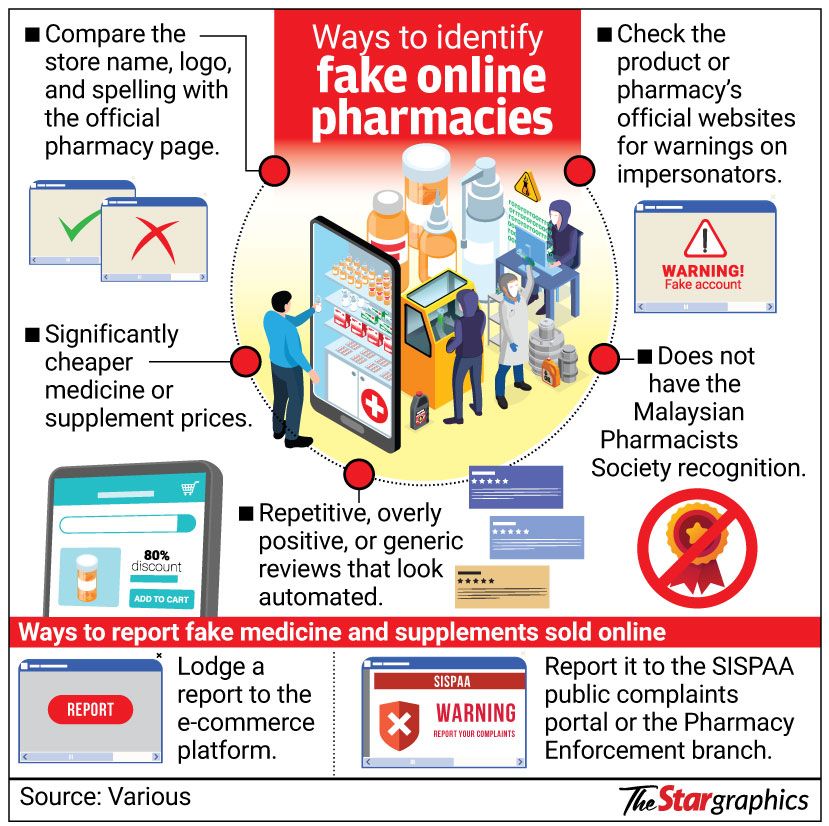
CLICK TO ENLARGE
CLICK TO ENLARGE

“The store looked almost identical. The only difference was that one of the letters bore a small alphabet as opposed to mine.

“Unregistered products in the Malaysian market were also sold on that site,” said Gan, who foun­ded a pharmacy in Kota Kemuning, Shah Alam.

This led to complaints being made to the said e-commerce platform. Several of the product postings were then removed.

Days later, however, more fake accounts emerged.

“What’s even more worrying is that these products are being purchased.

“Besides the impersonation, there are wider public health concerns,” she said.
Gan, who is honorary secretary of the Malaysian Community Pharmacy Guild, questioned how the said platform vets its sellers, especially for those related to sectors such as pharmaceuticals.

Her case is not an isolated one, as even chain pharmacies are being targeted by fraudulent operators.

“Over the past year, we noticed this becoming increasingly rampant.

“At first, we received custo­mer enquiries, with many also ­chec­king the authenticity of the products at our physical stores.

“So we checked the sites daily and lodged reports with the relevant authorities every time our brand name is misused to sell health and supplement products,” said Alpro Pharmacy professional care and development manager Ng Yi Ling.

These stores impersonate the Alpro brand, logo and images, she said.

The only difference was in the capitalisation of the letters in the brand name.

“Our biggest concern is how consuming these products will impact the health of consumers. We do not know the contents of these products,” she said.

Du Kiat Seng and Ng Seng Wei, who are the brand owners and sole distributor of a supplement product in Malaysia, said they have received complaints about counterfeit products as recently as March.

“We tried ordering the product ourselves and found that it was clearly a counterfeit.”

The give­away was the absence of mandatory hologram tags.

The registration number was also a duplicated one, they said.

Both of them found that posts of doubtful pro­ducts would be taken down ­following complaints but they would reappear the next day on the same online store.

“There should be some sense of responsibility from platforms to do their due diligence before allowing anyone to list health products for sale online.”

Brego Life Sciences marketing manager Claris Wong said they discovered such issues happening since 2024.

“We received complaints online. The prices were between 30% and 40% cheaper.

“We purchased the products and saw that they were almost identical with our products, although there were subtle diffe­rences in the printing.

“There was even a hologram printed on it. But when we scanned it, we found the product was not registered,” she said.

Sh said there was an instance where a customer was hospita­lised after consuming a counterfeit product.

“Counterfeit products are dangerous.

“Our tests revealed that they do not have any of the active ingre­dients as claimed and may also contain unknown or harmful substances,” she said.

Related stories:

Save a dime, risk a life? Beware of cheap fake meds online

PETALING JAYA: It may seem like a good bargain online. But it comes with serious risks, as counterfeit medicines and supplements are still being sold on e-commerce platforms despite ongoing crackdowns.

TikTok Shop Malaysia said medicines and supplements are subject to requirements, inclu­ding the need for a MAL number or notification from the National Pharma­­ceutical Regulatory Agency (NPRA), before being lis­ted.

“Through our Intellectual Property Protection Centre, brands or authorised representatives can submit takedown requests for products and monitor their st

“There is no finish line when it comes to safety. Users are encou­raged to report these products, content and sellers through the in-app reporting channel,” said a spokesperson.

TikTok Shop Malaysia is wor­king with the Domestic Trade and Cost of Living Ministry and Health Ministry to address evolving forms of circumvention.

The spokesperson said conti­nuous investments are made to improve safety tools, technology and personnel, with more than US$1bil committed globally to protect users from fraudulent and dangerous activities.

Automated systems are also used to detect potential fraud, infringement, unsafe content or violative product listings, both before and after products or content are uploaded.

“Sellers must submit official documentation during registration, which is then verified against business and banking details to ensure authenticity.

“Store names are subject to strict guidelines to prevent misrepresentation, including restrictions on terms such as ‘official’, ‘flagship’ or ‘authorised’,” the spokesperson said.

Once approved, new sellers undergo a probationary period where daily orders and product listings are capped as they fami­liarise themselves with platform policies.

Between January and June this year, it said more than 70 million product listing attempts were rejected globally for policy violations, with a proactive removal rate exceeding 99.5%.

Some 1.4 million seller account registration applications that failed to meet its standards were declined, with more than 700,000 sellers removed during the same period due to shop-level violations.

“More than 900,000 reports from users viewing TikTok Shop videos or live streams were also reviewed,” the spokesperson said.

Shopee strictly prohibits the sale of counterfeit and prohibited items too, requiring all sellers to comply with local regulations and platform policies.

A spokesperson said the platform works closely with the Malaysian Pharmacists Society (MPS) to verify pharmacies and actively remove listings that violate its rules.

“We are committed to building a safe and trusted platform where shoppers can transact with confidence.

“We also use proactive monitoring and work with brands, law enforcement and the Health Ministry to detect and take action against sellers breaching our policies, including account suspension, permanent bans and, where appropriate, legal action.

“Users are encouraged to report suspicious or counterfeit pro­ducts via the ‘Report this Product’ option.”

Complaints can also be made to the Public Complaints Manage­ment System (SISPAA), which is used to manage public complaints, including reports of fake or unregistered medicines.

MPS president Amrahi Buang said all pharmaceutical products sold online must be registered with the Health Ministry and comply with laws including the Poisons Act, Sale of Drugs Act and the Medicines (Advertisement & Sale) Act and Regulations.

“Legitimate products have the Health Ministry hologram tag and the MAL number,” he said, ­adding that the number can be checked at the NPRA website.

He said MPS also signed a memo­randum of understanding (MOU) with an e-commerce platform to curb the sale of counterfeit drugs online.

There are several conditions to be fulfilled when applying to open an online store as per the MOU, including having a licensed pharmacist, ensuring the pro­ducts sold online can be tied to a physical store and confirming that the pharmacist is an MPS member.

“Pharmacists can check if the product is legitimate and advise you.

“We don’t just sell drugs. We want the best for our customers,” he said


Saturday, 27 May 2023

Rise in chronic kidney disease

CLICK TO ENLARGE https://cdn.thestar.com.my/Content/Images/SlimmingProduct.jpg


Ministry: Taking unregistered health supplements one of contributing factor


PETALING JAYA: Almost 9,000 new kidney patients are registered annually, and they require dialysis treatment, says the Health Ministry.

The prevalence of chronic kidney disease (CKD) in Malaysia has been on the rise, it said.

“In Malaysia, one in seven of the 33 million population, or 4.7 million adults, have various stages of CKD.

“Preliminary data from the National Renal Registry (NRR) shows that there were 49,447 dialysis patients in Malaysia last year.

Of this number, 43,663 patients are undergoing hemodialysis treatment, while 5,784 go for peritoneal dialysis treatment,” the ministry said in a statement to The Star.

Overall, the prevalence of CKD had gone up from 9.07% in 2011 to 15.48% in 2018.

The ministry said that the consumption of unregistered health supplement products was among the factors contributing to kidney disease.

“From January 2018 until December 2022, the National Pharmaceutical Regulatory Agency (NPRA) received 67 reports of adverse events associated with renal functions suspected to be due to the consumption of health supplements.

“Of these, 14 were suspected to be due to the use of unregistered health supplements.

“The most frequently reported adverse events were acute kidney injury (six), increased blood creatinine (three) and acute chronic renal failure (two),” it said.

NPRA is responsible for monitoring the safety of registered products on the market, including health supplements.

“One of the key activities in monitoring the safety of the products is through adverse drug reaction (ADR) reporting by healthcare providers, pharmaceutical companies and consumers.

“The NPRA also receives ADR reports suspected to be due to the use of unregistered health supplement products, including those adulterated with illegal substances such as dexamethasone, chlorpheniramine, and sibutramine,” the ministry said.

From 2020 until March this year, the ministry confiscated 30,209 slimming products sold online, valued at almost RM1.27mil.

Through various efforts, the ministry has also been regulating and monitoring the sales of unregulated supplements on social media.

This includes ensuring pharmaceutical products, health supplements and traditional medicines are registered with the Drug Control Authority in accordance with the Control of Drugs and Cosmetics Regulations (CDCR) 1984.

For the purpose of marketing, the ministry said registered traditional medicines are only permitted low-level claims that indicate the purposes of the products.

“All proposed claims must be supported by reliable references.

“Excerpts from pharmacopoeias, monographs, published journals or articles, and data from clinical studies are generally accepted as evidence of use and product indication,” it said.

The ministry is also doing post-marketing surveillance activities, such as constantly monitoring the products that have been registered.

This was to ensure that all registered products that are marketed and supplied are safe and of good quality, it added.

Selling products that are not registered is an offence under Regulation 7 (1) (a) of the Control of Drugs and Cosmetics Regulations 1984.

It is also an offence under Regulation 30 (1) of the same Regulations.

Such an offence can be punished under Section 12 (1) or 12 (2) of the Sale of Drugs Act.

The ministry has been working with other government agencies and the private sector, including emarketplace platform providers, social media platforms and Internet-based service industries within and outside of Malaysia, to combat sales of unregulated products.

“Additionally, the ministry has partnered with other agencies, such as the Malaysian Communications and Multimedia Commission, to help in taking further action on content that breaches laws and regulations,” it said.

Besides this, the ministry has set up a cyberintelligence and forensics team within the Pharmaceutical Enforcement Division to monitor websites, social media and ecommerce platforms throughout Malaysia.

According to the ministry, the team served as a central point for their engagement with Internet platform providers like Facebook, Google and other similar companies.

“From 2020 to March 2023, a total of 1,345 advertisements related to weight loss or slimming products suspected of violating the Medicines (Advertisement and Sale) Act have been screened.

“Out of the total number of screened advertisements, five were found to promote products containing 2,4-Dinitrophenol (DNP),” it added.

DNP, which has been classified as a poison under the Poisons Act, is an organic compound that is usually used in the manufacturing industry as an industrial chemical.

It might also be used as an antiseptic.

The substance has been discovered in certain products that purport to help in weight reduction. 

 Source link


https://www.thestar.com.my/news/nation/2023/05/21/hidden-risks-in-illegal-ingredients-added-to-slimming-pills


QUOTED:

Malaysian Pharmacists Society president Amrahi Buang said the public should be wary of some herbal products sold in the illegal market and promoted as weight loss supplements.

“Some herbal products marketed for weight loss have been found to be adulterated with sibutramine, which is a controlled substance. It was previously used as an active ingredient in some weight loss pills.

“Sibutramine was removed from the market due to safety concerns, as it can significantly increase blood pressure and interact with other medications in life-threatening ways,” he said.

Amrahi said it was important for consumers to buy herbal weight loss products only from regulated producers while also receiving consultations from professionals.

For instance, a certain prescription for weight loss could be effective for some people, but it should still be used only with the guidance of a healthcare professional and taken together with a healthy diet and an exercise regimen, he said.

Malaysian Society of Nephrology president Dr Lily Mushahar said one should avoid taking slimming products with other medications as it could potentially cause organ failure.

“Slimming or weight loss pills can cause serious kidney, liver and organ failure.

“This damage can be reversible after stopping the drug, but sometimes it can cause permanent damage.

“Fat-blocking or herbal slimming drugs may have diuretic effects, causing crystal or stone formation that can irritate the kidneys,” she said.

According to the Health Ministry, the National Pharmaceutical Regulatory Agency (NPRA) has received several reports of adverse drug reactions due to the use of unregistered health supplement products. 

Related posts:

Bubbles Should Be In Your Drink, Not Your Urine 


 Keto acid therapy 

Sponsored

Image of NaturesPlus, Keto Living, Daily Multi, 90 Capsules
Digestive Support, Weight Support
·
Capsule
·
Vitamins
·
Unisex
Image of Keto Diet for Beginners - Audiobook
Free shipping
Audiobook
·
Cooking
·
Non-fiction
Image of ProRenal+D Kidney Multivitamins 90-Day Supply
Pill
·
Vitamins
·
Unisex
·
Adult
Image of Trace Minerals , Keto Electrolyte Tablets, 90 Tablets
Heart Support, Weight Support
·
Pill
·
Supplements
·
Unisex
Image of NaturesPlus, Keto Living, Natural Collagen, 1.36 lbs (616 g)
Hair, Skin & Nails, Immune Support, Weight Support
·
Powder
·
Supplements
·
Unisex
Image of Healthy Origins 7 Keto
RM 77.69 + tax
US$17.00 + tax
SameDaySuppl...
Weight Support
·
Capsule
·
Supplements
·
Unisex
Image of Best KETO Weight Loss Supplements Fat Burn Carb Blocker 120 Capsules
Cleanse, Energy, Weight Support
·
Capsule
·
Supplements
·
Unisex
Image of Keto Electrolyte Supplement (120 Capsules) Maximum Keto Electrolytes S
Energy, Weight Support
·
Capsule
·
Vitamins
·
Unisex
Image of Garden of Life, Dr. Formulated Keto, Organic MCT Powder, 10.58 oz (300 g)
Energy, Weight Support
·
Powder
·
Supplements
·
Unisex
Image of 7-Keto 120 Veg Caps By Now Foods
RM 163.19 + tax
US$35.71 + tax
HerbsPro.com
Weight Support
·
Capsule
·
Supplements
·
Unisex