Share This

Showing posts with label Bunn Nagara. Show all posts

Wednesday, 17 June 2026

Japan at a crossroads; inside unit 731


Unpopular move? Protesters hold placards and lights during a rally against Takaichi’s administration for its military expansion policies in front of the parliament building in Tokyo last month. — Reuters 
 

LAST Octo­ber Sanae Takai­chi became Japan’s first female leader of both the Lib­eral Demo­cratic Party (LDP) and the gov­ern­ment.

The “lib­eral” in the LDP actu­ally means con­ser­vat­ive. Takai­chi her­self belongs to the hard­line rightwing Nip­pon Kaigi fac­tion of the party.

Soon enough, she would come to brush against China. Respond­ing to a ques­tion, she said Japan would take mil­it­ary action if China moved on Taiwan and affected Japan’s interests.

That soured China-japan rela­tions, trig­ger­ing bit­ter WWII memor­ies of a rightwing mil­it­ar­ist Japan invad­ing, occupy­ing and com­mit­ting war crimes in China. Those wounds have yet to heal.

Mod­el­ling her­self after Bri­tain’s brazen first female Prime Min­is­ter Mar­garet Thatcher, Takai­chi was unapo­lo­getic. She fur­ther prod­ded Beijing by seek­ing to revise Japan’s post­war Con­sti­tu­tion to favour mil­it­ar­ism, and work­ing with the US and its allies to con­tain China.

Other coun­tries began to regard Takai­chi’s Japan as poten­tially revi­sion­ist, bent on white­wash­ing its his­tory of war atro­cit­ies and may even repeat them. So is Japan get­ting ready to remil­it­ar­ise?

At issue is Art­icle 9 of the Con­sti­tu­tion on Japan’s mil­it­ary forces, offi­cially the Self-defence Forces (SDF) after Japan’s sur­render in 1945. Takai­chi wants to remove the SDF’S con­sti­tu­tional con­straints to enable an assert­ive mil­it­ary pos­ture abroad.

That is chal­len­ging because it requires two-thirds major­it­ies in both the Lower and Upper Houses of the Diet. While the LDP lacks sup­port from the lat­ter, it is work­ing to boost mil­it­ary power, capa­city and reach in other ways.

For the first time since 1945, Japan par­ti­cip­ated prom­in­ently in this year’s Us-led Balikatan mil­it­ary exer­cises with live-fire drills in the South China Sea. Japan will also be export­ing lethal weapons, man­u­fac­tur­ing to scale and expand­ing mil­it­ary links abroad.

Must this mean Japan is return­ing to its mil­it­ar­ist past of a cen­tury ago? Much depends on the pre­vail­ing regional real­it­ies.

The US is encour­aging other coun­tries to play a big­ger regional defence role. This is as true for Asia as it is for Europe, and applies for both Repub­lican and Demo­cratic admin­is­tra­tions.

A 2012 Us-japan treaty would halve the 19,000 Mar­ines in Okinawa by return­ing them to Guam, Hawaii and the US main­land. Deploy­ments to the Phil­ip­pines tend to be more lim­ited and ad hoc.

In post-wwii East Asia, US mil­it­ary hege­mony is seen to keep the peace by remov­ing the need for Japan’s mil­it­ary build-up. The same applies with Ger­many in Europe.

However, US bipar­tisan policy is retrench­ing long-term regional mil­it­ary post­ings. Mil­it­ary forces will still be deployed for lim­ited mis­sions, such as in Iran or Venezuela, but major post­ings in far-flung regions are another mat­ter.

Regard­less of who is head­ing Japan’s gov­ern­ment, Tokyo will want to look more to itself for its defence role and com­mit­ments.

Unlike Ger­many, Japan is not seen by other coun­tries to have fully atoned for its imper­ial wars and the dev­ast­a­tion they unleashed. An unre­pent­ant rightwing leader now lead­ing an appar­ent mil­it­ary revival only exacer­bates Japan’s trust defi­cits.

Non­ethe­less, mod­ern East Asia’s real­it­ies would inhibit if not pro­hibit any ultra-nation­al­ist Japan­ese leader from return­ing to the coun­try’s imper­i­al­ist past.

Such an out­come will not be accept­able to West­ern powers because Japan­ese nation­al­ism is anti-west­ern. A rampant nation­al­ist Japan will ali­en­ate all other sig­ni­fic­ant powers in a more developed Asia and a more mul­ti­polar world.

Eco­nom­ic­ally, Japan’s best days are over so it has insuf­fi­cient resources to chal­lenge the sov­er­eignty of other global stake­hold­ers includ­ing Asia’s middle powers. Its eco­nomy has slipped below Ger­many’s and India’s to fifth place, and con­tin­ues slid­ing.

Socially and insti­tu­tion­ally, Japan­ese hawks may be in a minor­ity even in Japan. Groups and indi­vidu­als stage protests against per­ceived drifts towards mil­it­ar­ism, in a coun­try where dis­sent­ing voices mat­ter.

Even within the LDP and other main­stream insti­tu­tions, evid­ence of an exclus­ive, mono­lithic bloc favour­ing mil­it­ar­ism is sparse. The gen­eral pub­lic still tends to be averse to rad­ical con­sti­tu­tional changes.

Former Prime Min­is­ter Yukio Hat­oy­ama cri­ti­cised Takai­chi’s petty pop­u­lism, stress­ing that Taiwan’s status is China’s internal affair. Former Deputy Prime Min­is­ter Yohei Kono inves­ted a life­time in build­ing bridges with China.

Another former Prime Min­is­ter, Yasuo Fukuda, accepts rein­ter­pret­a­tion of Art­icle 9 without des­cend­ing into pop­u­list mil­it­ar­ism. In 2017, then Prime Min­is­ter Shinzo Abe declared that Japan was ready to cooper­ate with China in the Belt and Road Ini­ti­at­ive, des­pite Abe being another mem­ber of the LDP’S Nip­pon Kaigi fac­tion.

Pro­fessor Mike Moch­izuki says the way for Japan to work with a way­ward Trump-led US is not to ali­en­ate China, but instead to improve rela­tions with Beijing and deepen Tokyo’s stake in the region. Takai­chi also hap­pens to be reach­ing out to Asean coun­tries like Malay­sia in busi­ness deals, and this should be encour­aged.

Kono passed away last Monday, while fine-tun­ing new plans for cooper­at­ing with China. Whether Takai­chi’s real­ism will even­tu­ally out­live her pop­u­lism remains to be seen.

Bunn Nagara is dir­ector and senior fel­low of the Renais­sance Stra­tegic Research Insti­tute, and hon­or­ary fel­low at the Perak Academy. The views expressed here are solely the writer’s own.


By BUNN NAGARA
Bunn Nagara

Bunn Nagara is dir­ector and senior fel­low of the Renais­sance Stra­tegic Research Insti­tute, and hon­or­ary fel­low at the Perak Academy. The views expressed here are solely the writer’s own.

Related:

Share your videos with friends, family, and the world.
Missing:  ‎| Show results with: SINGAPORE,

Singapore historian Lim Shao Bin uncovers the hidden story of OKA 9420 - a secret Japanese germ warfare base established in Singapore during ..


Saturday, 13 December 2025

Hard to rewrite history

Loose cannon: Takaichi’s war talks have prompted Xi to call Trump to remind him that US and China were allies during WW2. — AFP

Japan’s new gov­ern­ment has had to take a crash course in inter­na­tional dip­lomacy as it learns for­eign policy on the job.

FROM curtailed Chinese tourism revenues to a suspended summit of Chinese, Japanese and South Korean leaders, Tokyo continues to reap the fallout from novice Prime Minister Sanae Takaichi’s combative style.

Just 17 days into taking office, she unnerved Chinese leaders by suggesting that Japan may attack China if Beijing forcibly reclaimed Taiwan. This was the most extreme declaration by any Japanese leader in decades.


Takai­chi’s far-right for­eign policy was not unex­pec­ted given her polit­ical record, but its extent and in com­ing so early in her term raised uncom­fort­able geo­pol­it­ical tem­per­at­ures.

Japan’s liab­il­it­ies in for­eign rela­tions con­tinue to grow, not only with China but also much of Asia dev­ast­ated by its war­time aggres­sion. China reacted most robustly because it suffered Imper­ial Japan’s worst depred­a­tions within liv­ing memory, with tens of mil­lions of civil­ians slaughtered and many more bru­tal­ised.

Unlike Ger­many that has fully atoned for its WWII atro­cit­ies, Japan has not. Takai­chi belongs to an ultrana­tion­al­ist fac­tion of the Lib­eral Demo­cratic Party and is a lead­ing mem­ber of the unre­pent­ant Nip­pon Kaigi (NK) organ­isa­tion that routinely denies Japan’s war crimes and praises its con­victed war crim­in­als as her­oes.

Japan and China may one day fully nor­m­al­ise rela­tions, but not yet. The wounds of war still run deep, their grav­ity fur­ther aggrav­ated by a gov­ern­ment that denies its hor­rors at the highest levels.

Hitler’s Holo­caust still haunts a post­war West that con­tin­ues to

give Israel a blank cheque to do any­thing. Revul­sion at Imper­ial Japan’s even worse mas­sacres in China may take longer to sub­side.

What upsets China fur­ther is Takai­chi’s cava­lier indif­fer­ence to the facts. Most coun­tries includ­ing the US and Japan have long had a one-china policy that does not recog­nise Taiwan as an inde­pend­ent nation, yet Japan’s Com­mon Defence doc­trine she cited for Taiwan applies only to assist­ance for sov­er­eign nations.

This implies that no basis exists for identi­fy­ing Taiwan’s per­ceived secur­ity interests with Japan’s. Even efforts to repu­di­ate Art­icle 9 of Japan’s post­war peace Con­sti­tu­tion through re-inter­pret­a­tion have been denounced by crit­ics as uncon­sti­tu­tional.

Attempts at re-inter­pret­a­tion to allow for greater assert­ive­ness are not widely accep­ted. It remains a highly con­tro­ver­sial issue at home and abroad.

Japan’s hope to become a ‘nor­mal coun­try’ no longer beholden to post­war US tutel­age is neither unreas­on­able nor lim­ited to ultra-con­ser­vat­ives, provided it can acknow­ledge its own past, recog­nise cur­rent real­it­ies and engage its neigh­bours fully with ‘nor­mal’ trust and con­fid­ence. That can­not hap­pen with revi­sion­ist lead­ers who are polit­ic­ally unre­formed and his­tor­ic­ally delu­sional bent on rewrit­ing his­tory.

Takai­chi’s state­ment about pos­sibly attack­ing a China that has not attacked it is reason enough for wide­spread alarm. Japan did pre­cisely that to China and a slew of other coun­tries by people who remain unapo­lo­getic about Pearl Har­bor and other tra­gedies.

That loose and dodgy inter­pret­a­tion of Japan’s national secur­ity interests promp­ted Pres­id­ent Xi to call up his US coun­ter­part and recount how China and the US were once allies in the war against fas­cism. Pres­id­ent Trump then advised Takai­chi to cool off.

Even Asian coun­tries inspired by Japan’s rapid indus­tri­al­isa­tion and eco­nomic growth remain wary of its ultra-nation­al­ists’ fas­cin­a­tion with remil­it­ar­isa­tion. Japan’s post­war rise was made pos­sible only with con­cili­at­ory rela­tions with its neigh­bours.

NK mem­bers have included former Prime Min­is­ters Shinzo Abe and Shi­geru Ishiba, but they have been less extreme than Takai­chi. Fol­low­ing her out­burst last month, Ishiba openly and repeatedly rep­rim­anded her.

Although the late Abe cham­pioned the Us-led Quad­ri­lat­eral Secur­ity Dia­logue (Quad) in try­ing to isol­ate China, he later relen­ted. In 2017 he declared Japan was ready to join the China-led Belt and Road Ini­ti­at­ive (BRI), and the fol­low­ing year Japan was reportedly engaged in sev­eral dozen BRI projects.

After los­ing WWII, Japan’s Yoshida Doc­trine relied on US pro­tec­tion to build its eco­nomic strength, developed the Fukuda Doc­trine to offer a meas­ure of war repar­a­tions, and issued the Murayama State­ment as a means to repair ties with neigh­bours. Now all those efforts may be under­mined, par­tic­u­larly when Trump is seek­ing peace with China and downs­iz­ing alli­ance oblig­a­tions all-round.

How Takai­chi’s admin­is­tra­tion now pro­ceeds with China will decide its own pro­spects. With eco­nomic stag­na­tion already in its fourth dec­ade, the Japan­ese ‘mir­acle’ is over.

But whether Japan then declines or can still thrive will depend on how, and if, it can work with a rising Asia helmed by Chinese entre­pren­eur­ship and pro­ductiv­ity.

Monday, 13 October 2025

Call for contingency plans in face of US govt shutdown


-Photo credit Reuters.

PETALING JAYA: Several export-oriented sectors in Malaysia will be impacted if there is a prolonged shutdown of the US government, say industry players.

As one of the country’s largest export markets, contingency plans should be drawn up to assist the affected sectors in weathering the effects of the political impasse in Washington DC.

Associated Chinese Chambers of Commerce and Industry of Malaysia treasurer-general Datuk Koong Lin Loong said that while the impact of a short-term shutdown would be minimal, an extended one would create a ripple effect on the US economy and Malaysian exporters.

“If US civil servants are not paid their salary, this will decrease their spending power and consumption. This in turn will affect the export of our furniture to the United States.

PETALING JAYA: Several export-oriented sectors in Malaysia will be impacted if there is a prolonged shutdown of the US government, say industry players.

As one of the country’s largest export markets, contingency plans should be drawn up to assist the affected sectors in weathering the effects of the political impasse in Washington DC.

Associated Chinese Chambers of Commerce and Industry of Malaysia treasurer-general Datuk Koong Lin Loong said that while the impact of a short-term shutdown would be minimal, an extended one would create a ripple effect on the US economy and Malaysian exporters.

“If US civil servants are not paid their salary, this will decrease their spending power and consumption. This in turn will affect the export of our furniture to the United States.

“Also, the shutdown will interrupt services such as customs clearance at the ports and entry points in the United States. This will become an issue for our exporters.

“The disruption to the logistics sector would have an impact on the supply chain.

“This will be especially true for Malaysian companies involved in the export of electrical and electronics (E&E) products to the United States, which is a major importer,” he said when contacted yesterday.

The United States is one of the largest importers of Malaysian E&E, totalling almost RM120bil last year and representing about 20% of the country’s total E&E exports.

Of these figures, some RM60bil were semiconductor products, which account for about 20% of Malaysia’s total semiconductor exports.

Koong suggests that Malaysia leverage its position as Asean Chair to coordinate with other Asean members states and regional countries in facilitating exports.

“We could leverage the strength of Asean as a whole in respect of the individual countries’ niche products and services,” he added.

If there is a prolonged shutdown, he said the government should assist exporters by exploring other potential markets such as the Middle East and Africa.

Koong noted that development grants and soft loans, which were announced in Budget 2026, could help small and medium enterprises (SMEs) weather the effects of a prolonged shutdown.

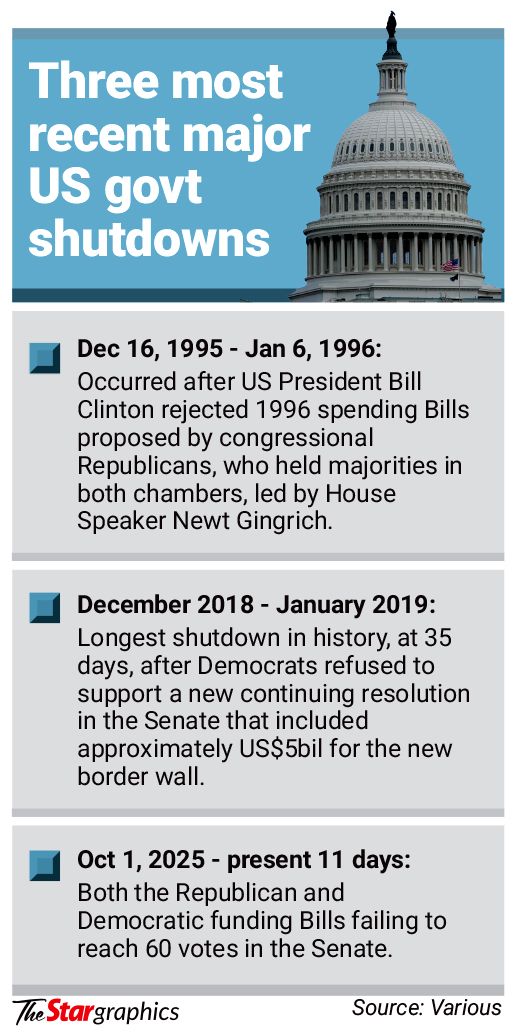
The US government shutdown, which began on Oct 1, was triggered by the US Congress’ rejection of a Republican funding Bill, resulting in some 750,000 federal government workers being furloughed without pay.

The deadlock is expected to persist for a third week despite pressure from President Donald Trump on the Democrats to support the Republican Bill.

Airfreight Forwarders Association of Malaysia chairman Thomas Mathew said the shutdown, though a US domestic political issue, carries far-reaching implications for the global economy.

“As one of the world’s largest importers and exporters, any disruption in the operations of US federal agencies reverberates through supply chains worldwide,” he said when contacted yesterday.

Among the immediate impacts of the shutdown are delays in customs clearance, port congestion and slower regulatory processing by key US agencies, he added.

“This includes the Customs and Border Protection (CBP), the Department of Commerce, and the Food and Drug Administration (FDA).

“These delays can significantly disrupt the flow of goods into and out of the United States, prompting re-routing, rescheduling, and increased costs across shipping networks,” he said.

Mathew said a prolonged shutdown would have a multifaceted impact on Malaysia, as the country is a key trading partner of the United States, particularly in the E&E and manufacturing sectors.

“Malaysia may encounter delays in order fulfilment, payment cycles, and reduced demand from US buyers facing their own domestic uncertainties,” he said.

He added that there could also be logistical slowdowns affecting compliance-dependent sectors that require US regulatory approvals, such as semiconductors, medical devices and pharmaceuticals.

“Additionally, any resulting market volatility may impact the ringgit, investor confidence and broader business sentiment in Malaysia,” he said.

While a short-term shutdown can be absorbed with minimal disruption, a prolonged one risks undermining the predictability and efficiency upon which global trade and export-driven economies rely on.

Mathew suggests that contingency plans are drafted for the affected sectors.

“Diversifying trade partnerships will be key for Malaysian businesses navigating such external shocks,” he added.

Malaysian Consortium of Mid-Tier Companies honorary president Callum Chen said a prolonged shutdown would be a double whammy to businesses, not only globally but also Malaysian too.

“The impact will make things worse. Ports in the United States are already jam-packed with stuck containers due to tariff uncertainties.

“Most US SMEs are already facing cash flow problems due to the tariffs,” he said when contacted.

He added that unpaid US federal workers would be forced to prioritise their spending.

“They will have less money to buy things, and their priority will be putting food on the table,” he said.

Chen expects the latest episode to be longer than the previous 35-day shutdown from Dec 22, 2018, to Jan 25, 2019, which is the longest in US history.

“Everyone is in a limbo and this only creates more uncertainty for businesses,” he said.

https://www.thestar.com.my/news/world/2025/10/11/white-house-says-substantial-us-government-job-cuts-have-begun

https://www.thestar.com.my/news/nation/2025/10/12/experts-theres-a-silver-lining-amid-us-shutdown


MOFCOM slams US' planned 100% additional tariff, says willful threats not right way to get along with China

China's Ministry of Commerce (MOFCOM) on Sunday slamm

Related posts:

  •   https://bbc.com/news/articles/crrj1znp0pyo Anthony Zurcher North America correspondent  and James FitzGerald   Watch: What could happen du...

Goodbye trade war

Goodbye trade war


China seems to be winning the tariff war even as Trump threatens to impose a massive increase of tariffs on Chinese imports in response to the republic's announcement of new export controls on rare earths. — Getty Images/AFP


South-east asia, once only a bruising trade war’s secondary victim, should now have asean showing its mettle as china wins.

BEYOND multiple global uncertainties are two core fundamentals: Us-china relations being the world’s most important bilateral relationship, and economics determining much of everything else.

This makes the trade war between the world’s two biggest economies pivotal to all. Multiple spheres in various regions are impacted accordingly.

That much is the main plot in today’s geopolitics. Problems tend to arise when the script is amended without warning, explanation or acknowledgement.

US President Donald Trump has sought a personal meeting with Chinese President Xi Jinping since last year, but that will happen only next year. Why does it take two years for such a crucial event to occur?

It is precisely because of the summit’s importance that it has to take so long. Unlike MOUS, summits do not set the tone of an intended agreement but to cap what has already been agreed.

Transnational deals are too important to be left to formal summits with their pomp and pageantry. The serious business of negotiations by government experts and specialists differs vastly from the PR theatre of official photo opportunities.

The months and years between signalling interest in a summit and actually holding it are for senior officials to work out sufficiently agreeable terms to constitute a deal. That period of talks by officials began informally last year between the incoming US administration and China’s incumbent team.

It is a period now effectively coming to a close in ending the trade war, but still only unofficially. The basic agreement that is now done in all but writing has the US broadly conceding to China’s terms.

China is the only country that has pushed back on Trump’s tariffs, with resounding effect as recent events show.

After Commerce Secretary Howard Lutnick’s grating condescension about supplying China with only Nvidia’s sub-par microchips, Beijing blocked all of Nvidia’s chips. Nvidia boss Jensen Huang said China’s own chip development is only “nano seconds behind” his company’s best products.

In agriculture, China has stopped buying US soybeans for supplies from Brazil and elsewhere. With US farmers devastated, China again demonstrated considerable leverage.

With Trump clamping down on countries buying Russian and Iranian oil and gas, India was hit with high additional tariffs, but not China. Instead, China raised Russian gas supplies with the Power of Siberia (POS) pipeline and now also POS 2.

China is also importing more than a million barrels of Iranian oil daily, amounting to almost 90% of Iran’s output. These major purchases were never going to be impacted by US restrictions.

Trump declared victory on Tiktok but it was a net gain for China. Beijing refused to sell Tiktok’s proprietary algorithm, the heart and brain of the winning platform.

A copy of the original algorithm was supplied to US investors, and China’s Bytedance owns just under 20% of US Tiktok – yet is entitled to 50% of US profits. US negotiators must have realised that was the most they could get from China’s tough bargaining position and accepted it.

China has introduced new restrictions on rare earth exports, launched an antitrust probe into US chip giant Qualcomm, and will raise port fees for US ships in return. In virtually every sector China is fighting back through tit-for-tat action and new policies.

If there is still any doubt that China is leading the charge of what remains of the trade war, its use of carrots and sticks to access the US market confirms it. Beijing has offered more than a trillion dollars (RM4.2 trillion) of investment in the US through Chinese companies admitted there.

These could include Chinese electric vehicle companies, which Trump last year said he would invite to the US to provide jobs. Only the stronger economy can dish out inducements of such proportions to the relatively subordinate economy.

Such is the substance of a negotiated trade peace. Ultimately, Trump is less concerned about what actually makes a trade victory than what can be interpreted and portrayed as his personal triumph.

He is anxious to gain snatches of a win between trade skirmishes, however fleeting or questionable, and China is only too happy to provide them to win the trade war. More of this can be expected at next year’s summit.

Meanwhile, Louis Gave of Hong Kong’s Gavekal Research has declared China’s trade war victory. South-east Asia should likewise flip the old script to its favour.

Asean countries are not just collateral economies subjected to the whims of a trade conflict. When China takes a beating, South-east Asia was assumed to be beaten also.

But the US still hopes to obtain from this region what it failed to get from China. To do this it needs to keep up appearances that it is winning over China as the centre of global supply chains.

Asean can call that bluff to protect itself.

Repated posts|:

  •   https://bbc.com/news/articles/crrj1znp0pyo Anthony Zurcher North America correspondent  and James FitzGerald   Watch: What could happen du...

Call for contingency plans in face of US govt shutdown